HM3: Hierarchical Multi-Objective Model Merging for Pretrained Models
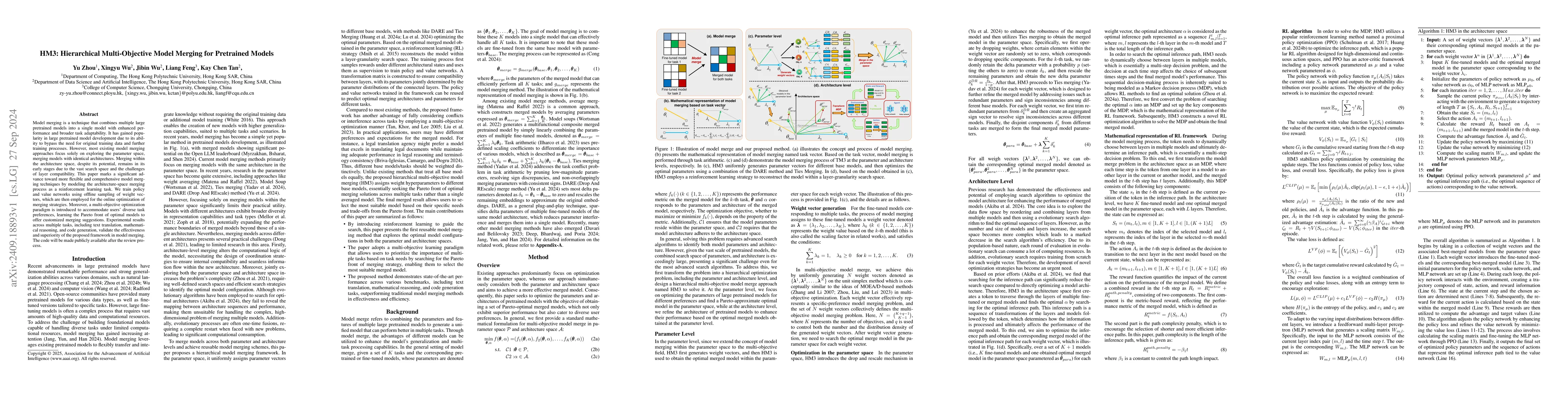
This paper proposes HM3, a Hierarchical Multi-Objective Model Merging technique that leverages reinforcement learning for merging models with different architectures, offering customizable merging strategies based on various task preferences. Experimental results demonstrate its effectiveness across diverse tasks.
Abstract
Model merging is a technique that combines multiple large pretrained models into a single model with enhanced performance and broader task adaptability. It has gained popularity in large pretrained model development due to its ability to bypass the need for original training data and further training processes. However, most existing model merging approaches focus solely on exploring the parameter space, merging models with identical architectures. Merging within the architecture space, despite its potential, remains in its early stages due to the vast search space and the challenges of layer compatibility. This paper marks a significant advance toward more flexible and comprehensive model merging techniques by modeling the architecture-space merging process as a reinforcement learning task. We train policy and value networks using offline sampling of weight vectors, which are then employed for the online optimization of merging strategies. Moreover, a multi-objective optimization paradigm is introduced to accommodate users' diverse task preferences, learning the Pareto front of optimal models to offer customized merging suggestions. Experimental results across multiple tasks, including text translation, mathematical reasoning, and code generation, validate the effectiveness and superiority of the proposed framework in model merging. The code will be made publicly available after the review process.
AI Key Findings
Get AI-generated insights about this paper's methodology, results, significance, and more — available when analysis has been generated.
Discussion 0