Image Trinarization Using a Partial Differential Equations: A Novel Approach to Automatic Sperm Image Analysis
Researchers propose a novel approach to image trinarization using partial differential equations for automatic sperm morphology analysis, achieving high performance compared to standard clustering methods.
Abstract
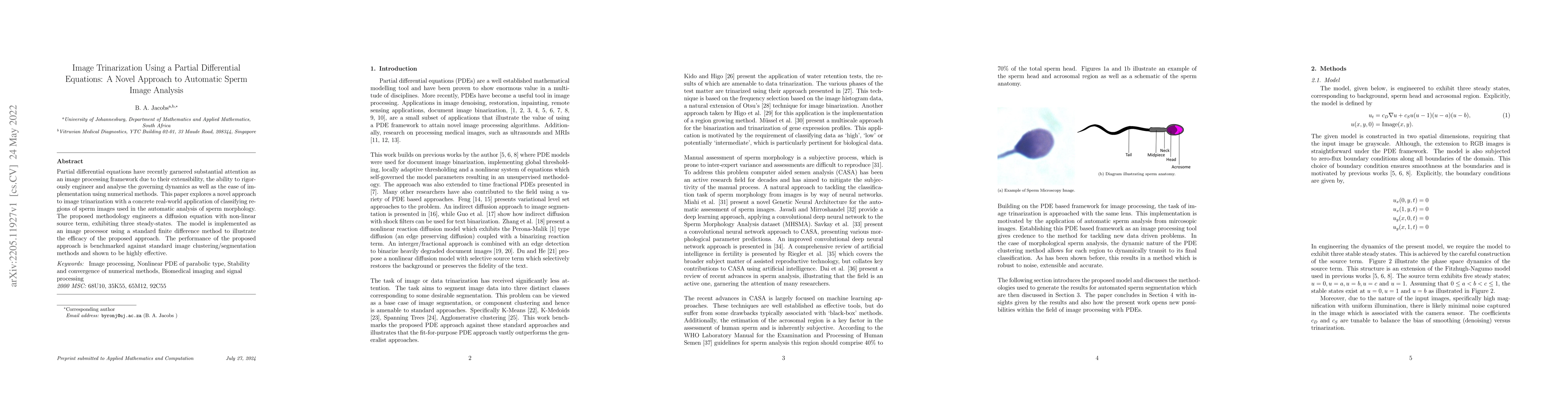
Partial differential equations have recently garnered substantial attention as an image processing framework due to their extensibility, the ability to rigorously engineer and analyse the governing dynamics as well as the ease of implementation using numerical methods. This paper explores a novel approach to image trinarization with a concrete real-world application of classifying regions of sperm images used in the automatic analysis of sperm morphology. The proposed methodology engineers a diffusion equation with non-linear source term, exhibiting three steady-states. The model is implemented as an image processor using a standard finite difference method to illustrate the efficacy of the proposed approach. The performance of the proposed approach is benchmarked against standard image clustering/segmentation methods and shown to be highly effective.
AI Key Findings
Get AI-generated insights about this paper's methodology, results, significance, and more — available when analysis has been generated.
Discussion 0