Improved Constants in the Kautz-Singleton Construction for Probabilistic Group Testing
Abstract
We consider the probabilistic nonadaptive group testing problem, in which a uniformly random defective set of size $d$ is to be identified among $N$ items using a binary test matrix. For the explicit Kautz--Singleton construction, it is known that order-optimal scaling $T=Θ(d\log N)$ for high-probability recovery can be achieved in the regime $d=Ω(\log^2 N)$. However, the leading constant in this scaling remains uncharacterized even for standard low-complexity decoders. In this work, we revisit the probabilistic analysis of this construction and improve the leading constant for the COMP decoder, as well as establishing the same bound for the DD decoder. Our approach relies on a sharper analysis of the number of distinct roots associated with the defective items, yielding tighter bounds on the decoding error probability. In particular, we show that both COMP and DD achieve vanishing average error probability with $T\le (1/\ln 2+\varepsilon)d\log N$ tests for any $\varepsilon>0$, in the admissible regime $N=q^k$ for some prime power $q = Θ(d)$ and integer $k \ge 2$. For COMP, this leading constant matches that of the random near-constant column weight design, whereas for DD, a gap remains except in the sparse regime $d = N^{o(1)}$.
Analysis
AI-generated · verify against the original paper
Generated Jan 1, 0001ResultsWhat the authors found
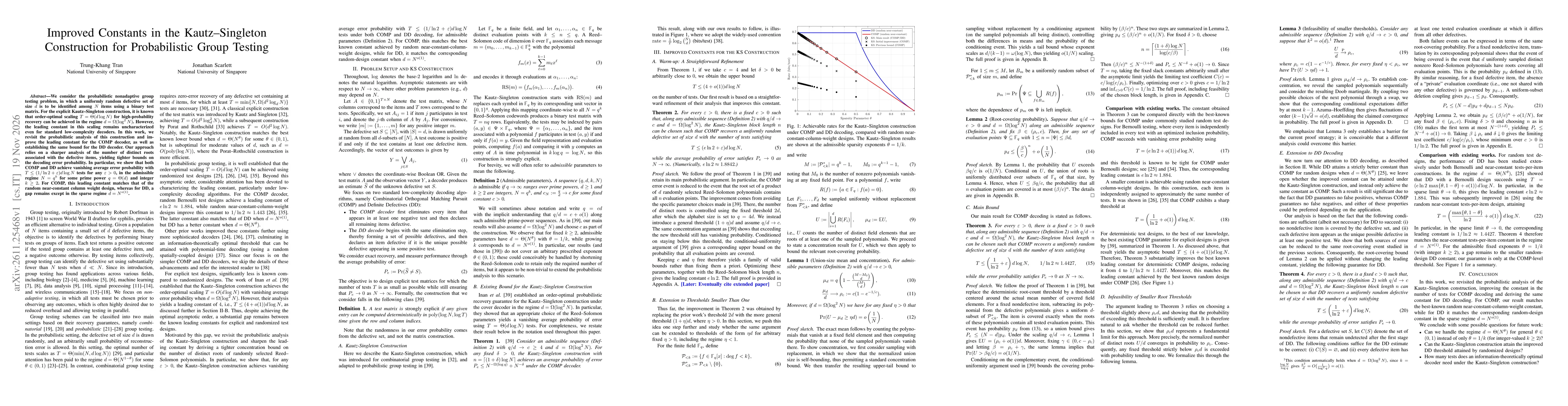
- Both COMP and DD decoders achieve vanishing average error probability with T ≤ (1/ln2 + ε) d log N tests for any ε > 0 under admissible parameters.
- For COMP, this leading constant matches the best known constant of random near‑constant‑column‑weight designs.
- For DD, the constant matches the random‑design constant only in the sparse regime d = N^{o(1)}; a gap remains otherwise.
LimitationsWhere the findings need caution
- Results are proved only for admissible parameters N = q^k with q = Θ(d) and k ≥ 2, requiring d = Ω(log^2 N).
- The analysis does not cover arbitrary sparsity exponents θ ∈ (0,1) or regimes where d is smaller than the admissible range.
- For DD decoding, the constant remains suboptimal outside the ultra‑sparse regime.
MethodologyHow the work was done
The authors perform a sharper probabilistic analysis of the Kautz–Singleton construction by tightly bounding the number of distinct roots of randomly selected Reed–Solomon polynomials, using concentration inequalities (Azuma–Hoeffding) and martingale techniques to derive tighter error probability bounds for the COMP and DD decoders.
SignificanceWhy the work matters
The work closes the constant‑factor gap between explicit Kautz–Singleton designs and random designs for COMP decoding, establishing the first explicit construction with the optimal 1/ln2 leading constant in the probabilistic setting.
Technical contributionsWhat the work introduces
Introduces a refined root‑covering probability analysis and a martingale concentration framework that yields a tighter leading constant for the test count in explicit Kautz–Singleton group testing designs.
NoveltyHow it differs from prior work
First to achieve the 1/ln2 leading constant for the explicit Kautz–Singleton construction with low‑complexity COMP and DD decoders in the probabilistic non‑adaptive group testing setting.
Future workQuestions that remain
- Extending the analysis to cover arbitrary sparsity exponents and non‑admissible parameter regimes.
- Improving the DD decoder constant to match the random‑design optimum for broader ranges of d.
- Investigating whether similar root‑count techniques can tighten constants for other explicit constructions.
Discussion 0