Including Uncertainty when Learning from Human Corrections
Abstract
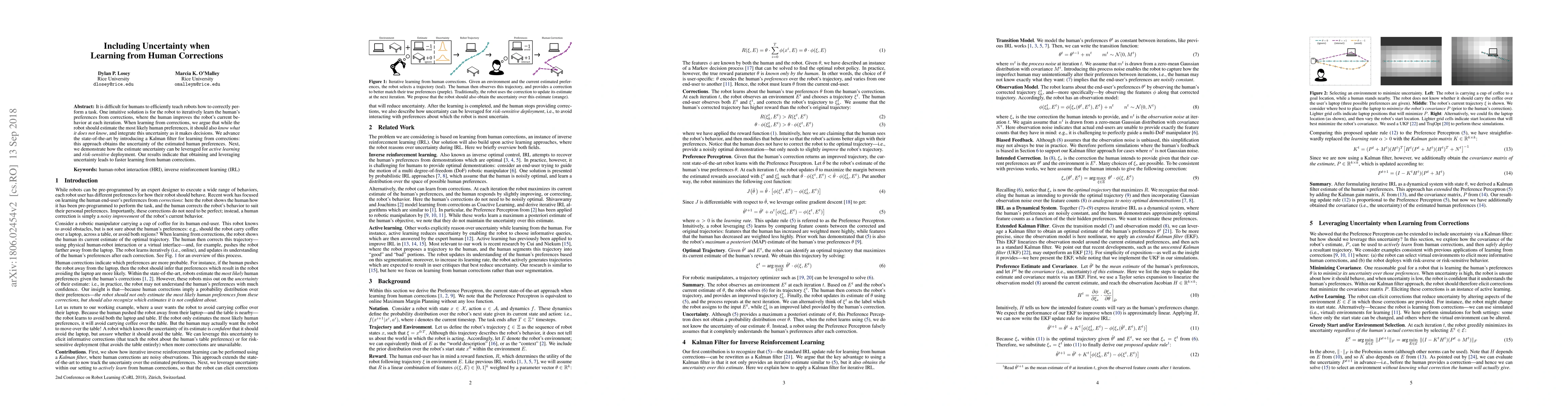
It is difficult for humans to efficiently teach robots how to correctly perform a task. One intuitive solution is for the robot to iteratively learn the human's preferences from corrections, where the human improves the robot's current behavior at each iteration. When learning from corrections, we argue that while the robot should estimate the most likely human preferences, it should also know what it does not know, and integrate this uncertainty as it makes decisions. We advance the state-of-the-art by introducing a Kalman filter for learning from corrections: this approach obtains the uncertainty of the estimated human preferences. Next, we demonstrate how the estimate uncertainty can be leveraged for active learning and risk-sensitive deployment. Our results indicate that obtaining and leveraging uncertainty leads to faster learning from human corrections.
AI Key Findings
Get AI-generated insights about this paper's methodology, results, significance, and more — available when analysis has been generated.
Discussion 0