Injecting Knowledge in Data-driven Vehicle Trajectory Predictors
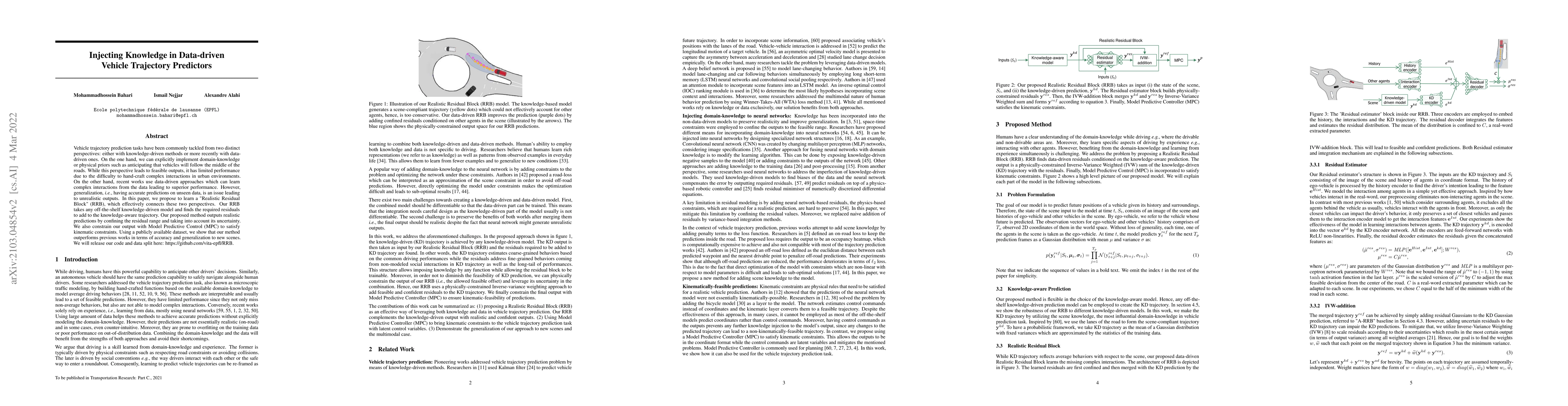
This paper proposes a "Realistic Residual Block" (RRB) to enhance data-driven vehicle trajectory prediction by integrating knowledge-driven methods, achieving superior accuracy and generalization compared to purely data-driven approaches. The RRB refines knowledge-driven models with learned residuals, constrained by Model Predictive Control to ensure realistic and kinematically feasible predictions.
Abstract
Vehicle trajectory prediction tasks have been commonly tackled from two distinct perspectives: either with knowledge-driven methods or more recently with data-driven ones. On the one hand, we can explicitly implement domain-knowledge or physical priors such as anticipating that vehicles will follow the middle of the roads. While this perspective leads to feasible outputs, it has limited performance due to the difficulty to hand-craft complex interactions in urban environments. On the other hand, recent works use data-driven approaches which can learn complex interactions from the data leading to superior performance. However, generalization, \textit{i.e.}, having accurate predictions on unseen data, is an issue leading to unrealistic outputs. In this paper, we propose to learn a "Realistic Residual Block" (RRB), which effectively connects these two perspectives. Our RRB takes any off-the-shelf knowledge-driven model and finds the required residuals to add to the knowledge-aware trajectory. Our proposed method outputs realistic predictions by confining the residual range and taking into account its uncertainty. We also constrain our output with Model Predictive Control (MPC) to satisfy kinematic constraints. Using a publicly available dataset, we show that our method outperforms previous works in terms of accuracy and generalization to new scenes. We will release our code and data split here: https://github.com/vita-epfl/RRB.
AI Key Findings
Get AI-generated insights about this paper's methodology, results, significance, and more — available when analysis has been generated.
Discussion 0