Integrating Learned Priors through Prior-Space Reparameterization for Physically Based Inverse Rendering
Abstract
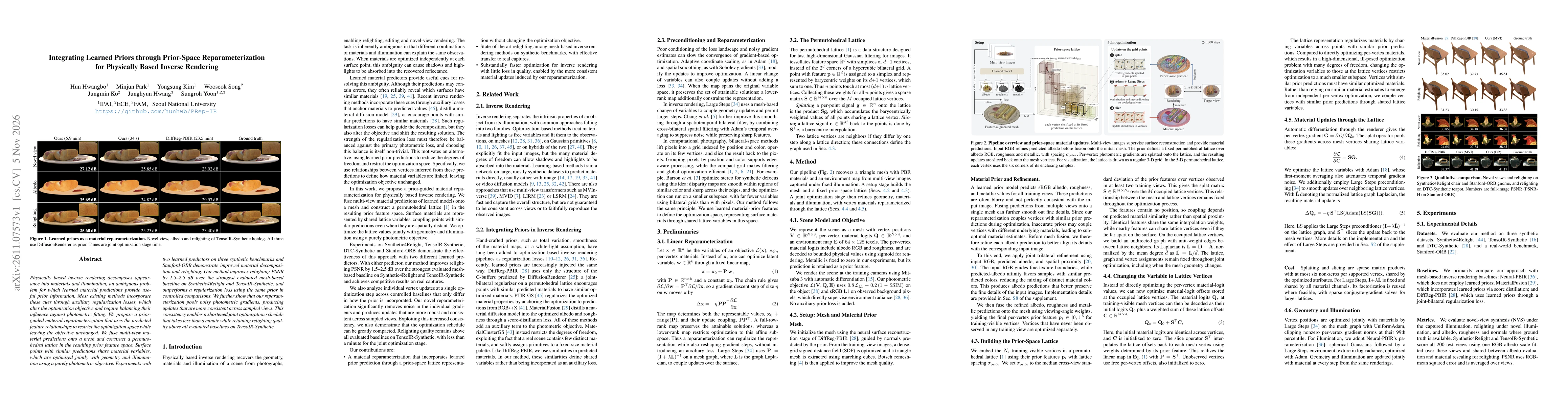
Physically based inverse rendering decomposes appearance into materials and illumination, an ambiguous problem for which learned material predictions provide useful prior information. Most existing methods incorporate these cues through auxiliary regularization losses, which alter the optimization objective and require balancing their influence against photometric fitting. We propose a prior-guided material reparameterization that uses the predicted feature relationships to restrict the optimization space while leaving the objective unchanged. We fuse multi-view material predictions onto a mesh and construct a permutohedral lattice in the resulting prior feature space. Surface points with similar predictions share material variables, which are optimized jointly with geometry and illumination using a purely photometric objective. Experiments with two learned predictors on three synthetic benchmarks and Stanford-ORB demonstrate improved material decomposition and relighting. Our method improves relighting PSNR by 1.5-2.5 dB over the strongest evaluated mesh-based baseline on Synthetic4Relight and TensoIR-Synthetic, and outperforms a regularization loss using the same prior in controlled comparisons. We further show that our reparameterization pools noisy photometric gradients, producing updates that are more consistent across sampled views. This consistency enables a shortened joint optimization schedule that takes less than a minute while retaining relighting quality above all evaluated baselines on TensoIR-Synthetic.
Analysis
AI-generated · verify against the original paper
Generated Jan 1, 0001ResultsWhat the authors found
- Improves relighting PSNR by 1.5–2.5 dB over the strongest mesh‑based baseline on Synthetic4Relight and TensoIR‑Synthetic.
- Outperforms a regularization loss using the same prior in controlled comparisons.
- Reduces joint optimization time to less than a minute (≈34 s) while retaining relighting quality above all evaluated baselines on TensoIR‑Synthetic.
- Pools noisy photometric gradients, producing more consistent updates across sampled views.
LimitationsWhere the findings need caution
- The fused prior may lack fine‑grained detail, causing loss of subtle lettering and contrast before refinement.
- Prior refinement only modestly improves quantitative metrics and does not consistently enhance every metric.
MethodologyHow the work was done
The authors fuse multi-view learned material predictions onto a mesh and construct a permutohedral lattice in the resulting prior feature space. Surface points with similar predictions share material variables, which are jointly optimized with geometry and illumination using a purely photometric objective, leaving the optimization objective unchanged.
SignificanceWhy the work matters
The approach demonstrates that learned material priors can be incorporated as a reparameterization that tightens the solution space without altering the photometric loss, leading to better material decomposition, higher‑quality relighting, and substantially faster inverse‑rendering pipelines.
Technical contributionsWhat the work introduces
Introduces a prior‑guided material reparameterization that uses a permutohedral lattice to share material variables among points with similar learned predictions, enabling joint optimization of material, geometry, and illumination without auxiliary regularization terms.
NoveltyHow it differs from prior work
Unlike prior methods that add auxiliary regularization losses, this work restricts the optimization degrees of freedom directly via a learned‑prior space representation, preserving the original photometric objective while leveraging learned cues.
Discussion 0