Interband Plasmonics with p-block Elements
Researchers discover that non-noble metals like Bi, Sb, and Ga exhibit unique plasmonic properties in the near-ultraviolet visible range due to interband transitions, which can lead to tunable nanostructures and metamaterials.
Abstract
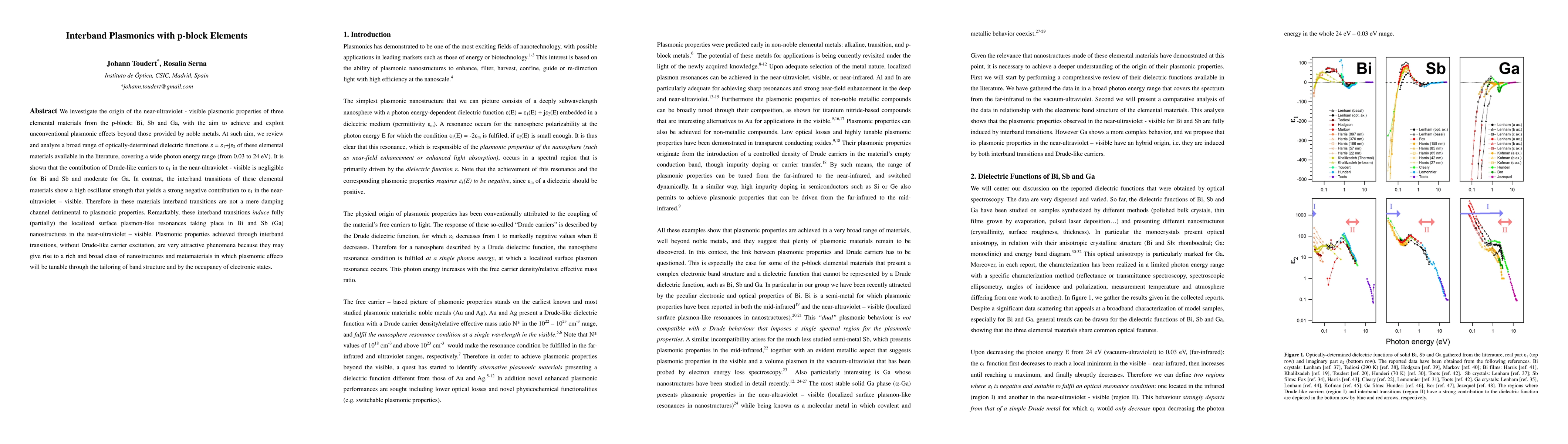
We investigate the origin of the near-ultraviolet visible plasmonic properties of three elemental materials from the p-block: Bi, Sb and Ga, with the aim to achieve and exploit unconventional plasmonic effects beyond those provided by noble metals. At such aim, we review and analyze a broad range of optically-determined dielectric functions e of these elemental materials available in the literature, covering a wide photon energy range (from 0.03 to 24 eV). It is shown that the contribution of Drude-like carriers to e1 (real part of e) in the near-ultraviolet visible is negligible for Bi and Sb and moderate for Ga. In contrast, the interband transitions of these elemental materials show a high oscillator strength that yields a strong negative contribution to e1 in the near-ultraviolet visible. Therefore in these materials interband transitions are not a mere damping channel detrimental to plasmonic properties. Remarkably, these interband transitions induce fully (partially) the localized surface plasmon-like resonances taking place in Bi and Sb (Ga) nanostructures in the near-ultraviolet visible. Plasmonic properties achieved through interband transitions, without Drude-like carrier excitation, are very attractive phenomena because they may give rise to a rich and broad class of nanostructures and metamaterials in which plasmonic effects will be tunable through the tailoring of band structure and by the occupancy of electronic states.
Analysis
AI-generated · verify against the original paper
Generated Sep 5, 2025ResultsWhat the authors found
- Main finding 1
- Main finding 2
- Main finding 3
LimitationsWhere the findings need caution
- Limitation 1
- Limitation 2
MethodologyHow the work was done
Brief description of the research methodology used
SignificanceWhy the work matters
Why this research is important and its potential impact
Technical contributionsWhat the work introduces
Main technical or theoretical contribution
NoveltyHow it differs from prior work
What makes this work novel or different from existing research
Future workQuestions that remain
- Suggested direction 1
- Suggested direction 2
Discussion 0