Lang3DSG: Language-based contrastive pre-training for 3D Scene Graph prediction
This paper introduces Lang3DSG, a novel language-based contrastive pre-training method for 3D scene graph prediction, leveraging CLIP's language encoder to align text embeddings with predicted graph features. The approach achieves state-of-the-art results and demonstrates zero-shot prediction capabilities by querying the language space of the features.
Abstract
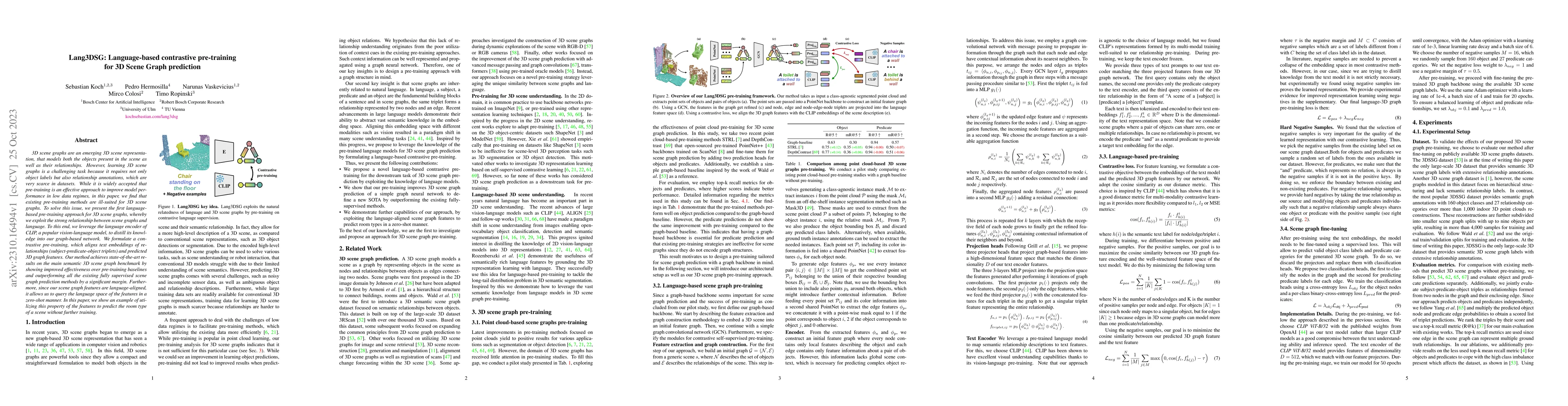
D scene graphs are an emerging 3D scene representation, that models both the objects present in the scene as well as their relationships. However, learning 3D scene graphs is a challenging task because it requires not only object labels but also relationship annotations, which are very scarce in datasets. While it is widely accepted that pre-training is an effective approach to improve model performance in low data regimes, in this paper, we find that existing pre-training methods are ill-suited for 3D scene graphs. To solve this issue, we present the first language-based pre-training approach for 3D scene graphs, whereby we exploit the strong relationship between scene graphs and language. To this end, we leverage the language encoder of CLIP, a popular vision-language model, to distill its knowledge into our graph-based network. We formulate a contrastive pre-training, which aligns text embeddings of relationships (subject-predicate-object triplets) and predicted 3D graph features. Our method achieves state-of-the-art results on the main semantic 3D scene graph benchmark by showing improved effectiveness over pre-training baselines and outperforming all the existing fully supervised scene graph prediction methods by a significant margin. Furthermore, since our scene graph features are language-aligned, it allows us to query the language space of the features in a zero-shot manner. In this paper, we show an example of utilizing this property of the features to predict the room type of a scene without further training.
AI Key Findings
Get AI-generated insights about this paper's methodology, results, significance, and more — available when analysis has been generated.
Discussion 0