Learning 3D MRI Representations with Generative Adversarial Networks
Abstract
Learning representations of visual images is a challenging task. It requires extracting abstract patterns from high-dimensional data without explicit supervision. This becomes pronounced with 3D MR imaging due to sparse features, higher dimensional inputs, and smaller datasets. Many state-of-the-art representation learning algorithms successfully rely on transformers and diffusion-based architectures. However, these methods struggle with smaller datasets. In effect, solution methods relax the problem by slicing 3D volumes and solving the problem for 2D medical imaging, resulting in a loss of spatial 3D information. We present R2RG, a representation learning method based on Convolutional Neural Networks (CNNs), with Generative Adversarial Networks (GANs) honing the reconstruction task. Our key insights lie in exploiting architectural biases in 3D CNNs, combined with data-efficient auto-encoding GANs and a composite loss function to enhance reconstruction fidelity and stabilize training. Our experiments on three standard datasets and a locally collected dataset show that R2RG not only achieves superior performance but also generalizes to heterogeneous and smaller datasets. Furthermore, representations learned with R2RG outperform those learned with contrastive-based representation learning methods on Parkinson's and Alzheimer's disease classification. Our work demonstrates that reconstruction-based representation learning is a promising direction for 3D medical imaging under limited data availability.
Analysis
AI-generated · verify against the original paper
Generated Jan 1, 0001ResultsWhat the authors found
- R2RG achieves superior reconstruction performance and representation quality on three standard MRI datasets and a locally collected dataset.
- The learned representations generalize to heterogeneous and smaller datasets.
- R2RG outperforms contrastive-based representation learning methods on Parkinson's and Alzheimer's disease classification tasks.
MethodologyHow the work was done
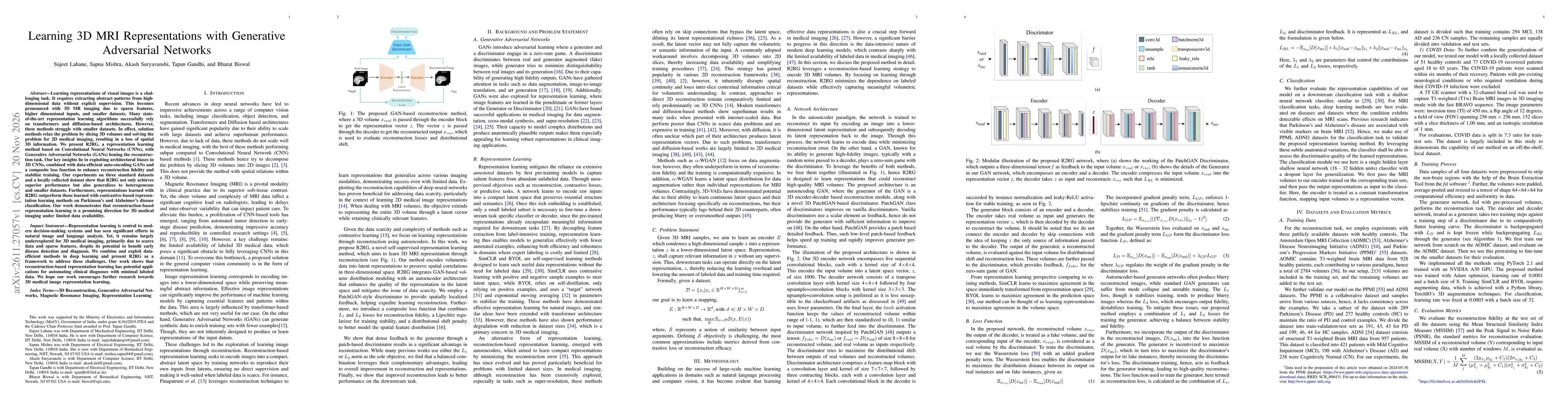
R2RG employs a 3D convolutional neural network autoencoder enhanced with a generative adversarial network, using a PatchGAN discriminator and a composite loss combining L1, L2, Lipschitz regularization, and distributional shift penalties to learn MRI representations.
SignificanceWhy the work matters
The work demonstrates that reconstruction-based self‑supervised learning with GANs can effectively capture 3D spatial information in MRI, providing a data‑efficient alternative to transformer and diffusion models for medical imaging with limited labeled data.
Technical contributionsWhat the work introduces
Integration of architectural biases of 3D CNNs with a data‑efficient auto‑encoding GAN and a novel composite loss function to improve reconstruction fidelity, training stability, and downstream classification performance.
NoveltyHow it differs from prior work
First approach to leverage GAN‑based reconstruction for learning 3D MRI representations without slicing volumes, addressing data scarcity and preserving full volumetric context.
Discussion 0