Learning long-range spatial dependencies with horizontal gated-recurrent units
This paper introduces the horizontal gated-recurrent unit (hGRU) to address the limitations of convolutional neural networks in recognizing long-range spatial dependencies. The hGRU layer is shown to match or outperform more complex feedforward architectures, demonstrating its effectiveness in detecting co-dependent visual features over long distances.
Abstract
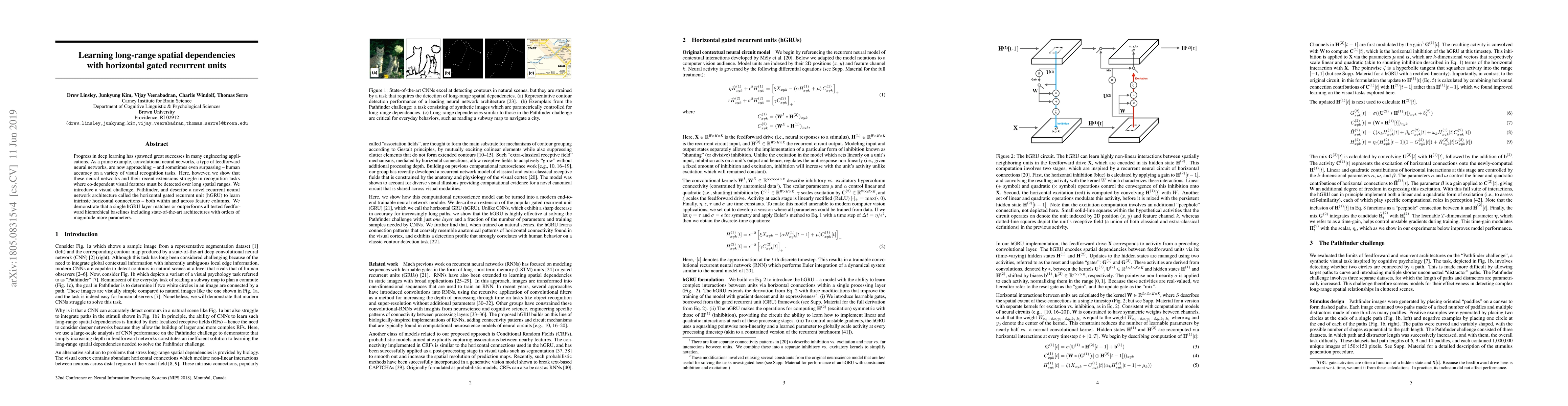
Progress in deep learning has spawned great successes in many engineering applications. As a prime example, convolutional neural networks, a type of feedforward neural networks, are now approaching -- and sometimes even surpassing -- human accuracy on a variety of visual recognition tasks. Here, however, we show that these neural networks and their recent extensions struggle in recognition tasks where co-dependent visual features must be detected over long spatial ranges. We introduce the horizontal gated-recurrent unit (hGRU) to learn intrinsic horizontal connections -- both within and across feature columns. We demonstrate that a single hGRU layer matches or outperforms all tested feedforward hierarchical baselines including state-of-the-art architectures which have orders of magnitude more free parameters. We further discuss the biological plausibility of the hGRU in comparison to anatomical data from the visual cortex as well as human behavioral data on a classic contour detection task.
AI Key Findings
Get AI-generated insights about this paper's methodology, results, significance, and more — available when analysis has been generated.
Discussion 0