LiveVAE: Causal Window Attention Makes Efficient Streaming Video VAE
Abstract
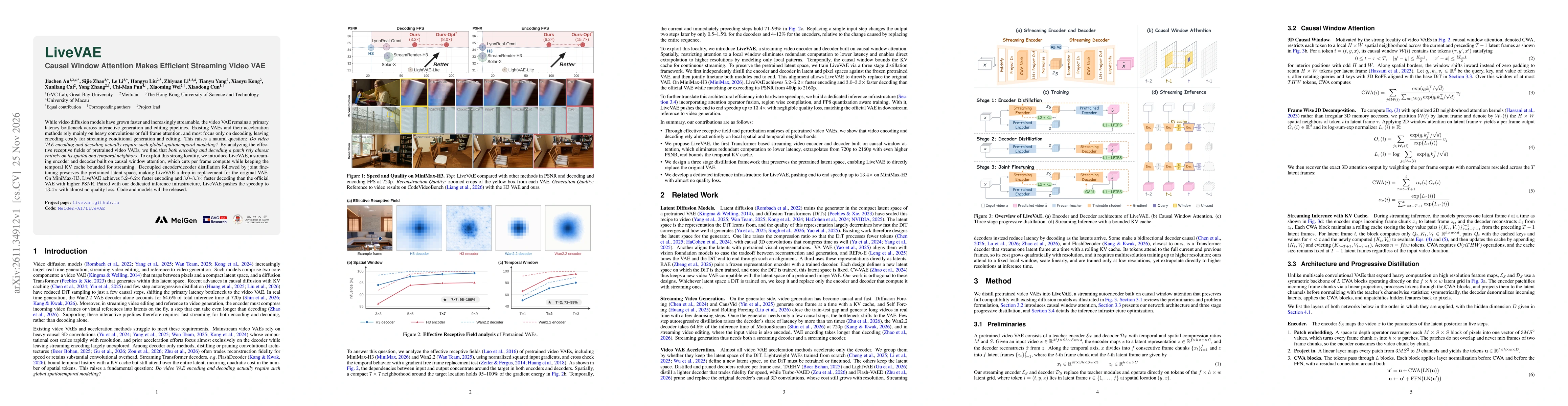
While video diffusion models have grown faster and increasingly streamable, the video VAE remains a primary latency bottleneck across interactive generation and editing pipelines. Existing VAEs and their acceleration methods rely mainly on heavy convolutions or full frame attention, and most focus only on decoding, leaving encoding costly for streaming conditional generation and editing. This raises a natural question: Do video VAE encoding and decoding actually require such global spatiotemporal modeling? By analyzing the effective receptive fields of pretrained video VAEs, we find that both encoding and decoding a patch rely almost entirely on its spatial and temporal neighbors. To exploit this strong locality, we introduce LiveVAE, a streaming encoder and decoder built on causal window attention, which cuts per frame compute while keeping the temporal KV cache bounded for streaming. Decoupled encoder/decoder distillation followed by joint finetuning preserves the pretrained latent space, making LiveVAE a drop-in replacement for the original VAE. On MiniMax-H3, LiveVAE achieves 5.2-6.2x faster encoding and 3.0-3.3x faster decoding than the official VAE with higher PSNR. Paired with our dedicated inference infrastructure, LiveVAE pushes the speedup to 13.4x with almost no quality loss. Code and models will be released.
Analysis
AI-generated · verify against the original paper
Generated Jan 1, 0001ResultsWhat the authors found
- LiveVAE achieves 5.2–6.2× faster encoding and 3.0–3.3× faster decoding than the official MiniMax‑H3 VAE while attaining higher PSNR.
- When combined with dedicated inference infrastructure, overall speedup reaches 13.4× with almost no quality loss.
- Ablation studies show that spatial window size 7×7 and temporal windows up to 7 frames retain 95–100% of gradient energy, confirming the effectiveness of the locality‑based design.
LimitationsWhere the findings need caution
- Evaluations are limited to the MiniMax‑H3 dataset and specific resolutions (480p–2160p), so generalization to other video VAE architectures remains unverified.
- The approach relies on a pre‑trained VAE for distillation; training a new VAE from scratch with causal window attention is not addressed.
MethodologyHow the work was done
LiveVAE introduces a streaming video VAE architecture that replaces heavy convolutions and full-frame attention with causal window attention for both encoder and decoder. It leverages the observed locality of effective receptive fields, applying a spatial 7×7 and limited temporal window, and employs decoupled encoder/decoder distillation followed by joint fine‑tuning to preserve the pretrained latent space.
SignificanceWhy the work matters
By dramatically reducing the VAE latency for both encoding and decoding, LiveVAE removes the primary bottleneck in real‑time video diffusion pipelines, enabling interactive generation, streaming video editing, and reference‑to‑video tasks at higher resolutions.
Technical contributionsWhat the work introduces
The paper presents causal window attention as a lightweight, streaming‑compatible alternative to global spatiotemporal modeling in video VAEs, together with a distillation‑based pipeline that preserves the original latent space, delivering a drop‑in replacement that significantly speeds up both encoding and decoding.
NoveltyHow it differs from prior work
LiveVAE uniquely exploits the strong locality of pretrained video VAE receptive fields to design a causal window attention mechanism that reduces computational cost while maintaining quality, a departure from prior work that focuses on heavy convolutions or full‑frame attention.
Future workQuestions that remain
- Extend the causal window attention framework to other video VAE models and larger, more diverse video datasets.
- Investigate adaptive window sizes and dynamic caching strategies to further balance speed and quality.
Discussion 0