Lyris: Layout-Guided Long Video Generation with Persistent 3D Memory
Abstract
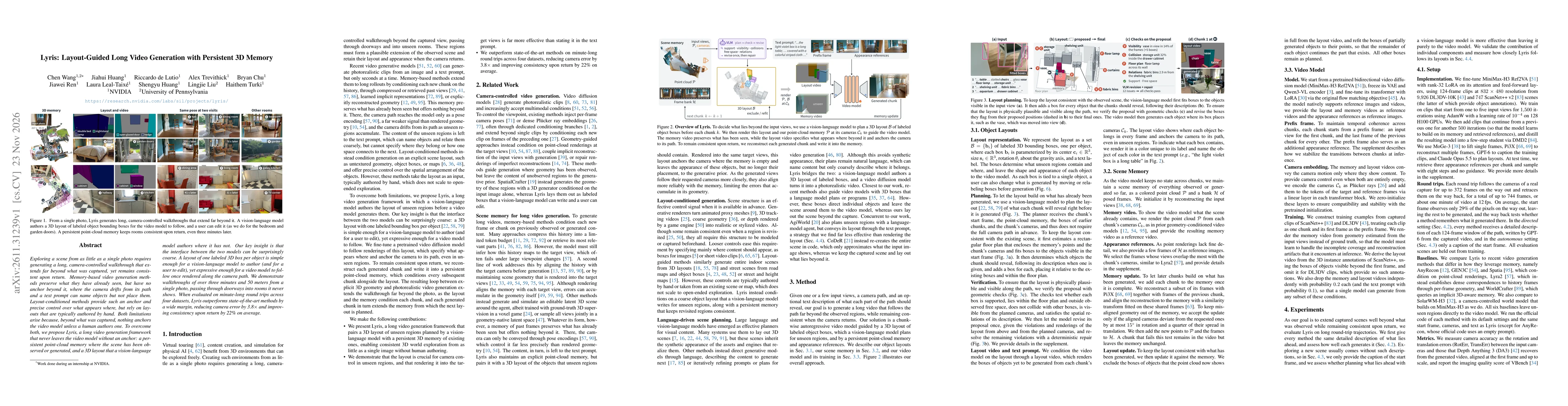
Exploring a scene from as little as a single photo requires generating a long, camera-controlled walkthrough that extends far beyond what was captured, yet remains consistent upon return. Memory-based video generation methods preserve what they have already seen, but have no anchor beyond it, where the camera drifts from its path and a text prompt can name objects but not place them. Layout-conditioned methods provide such an anchor and precise control over what appears where, but rely on layouts that are typically authored by hand. Both limitations arise because, beyond what was captured, nothing anchors the video model unless a human authors one. To overcome both, we propose Lyris, a long video generation framework that never leaves the video model without an anchor: a persistent point-cloud memory where the scene has been observed or generated, and a 3D layout that a vision-language model authors where it has not. Our key insight is that the interface between the two models can be surprisingly coarse. A layout of one labeled 3D box per object is simple enough for a vision-language model to author (and for a user to edit), yet expressive enough for a video model to follow once rendered along the camera path. We demonstrate walkthroughs of over three minutes and 50 meters from a single photo, passing through doorways into rooms it never shows. When evaluated on minute-long round trips across four datasets, Lyris outperforms state-of-the-art methods by a wide margin, reducing camera error by 3.8x and improving consistency upon return by 22% on average.
AI Key Findings
Get AI-generated insights about this paper's methodology, results, significance, and more — available when analysis has been generated.
Discussion 0