MoR4Rec: Mixture-of-Recursion for Sequential Recommendation
Abstract
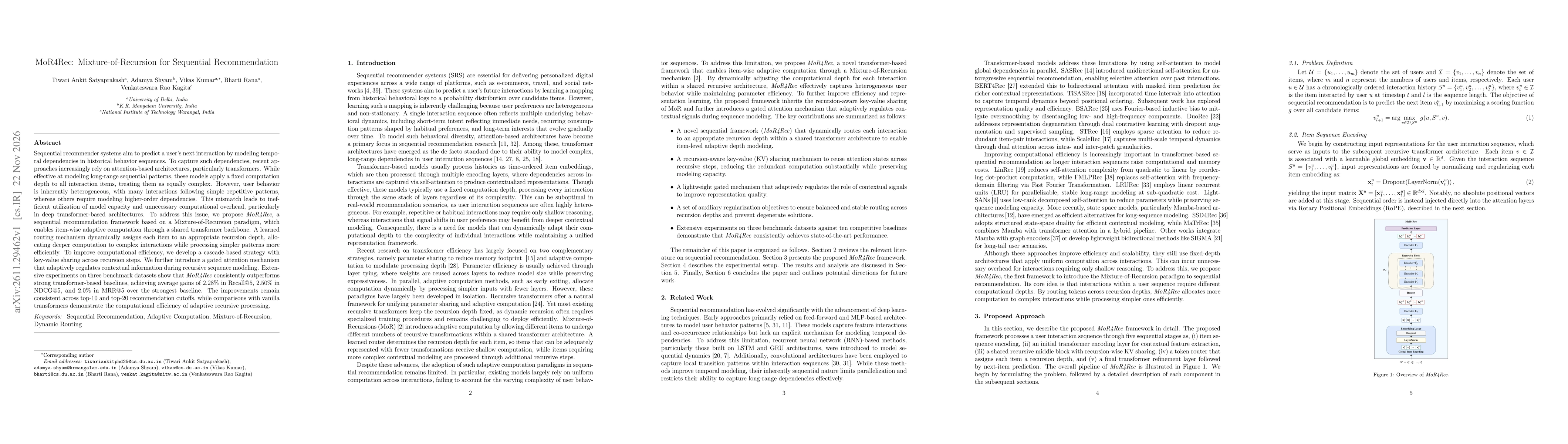
Sequential recommender systems aim to predict a user's next interaction by modeling temporal dependencies in historical behavior sequences. To capture such dependencies, recent approaches increasingly rely on attention-based architectures, particularly transformers. While effective at modeling long-range sequential patterns, these models apply a fixed computation depth to all interaction items, treating them as equally complex. However, user behavior is inherently heterogeneous, with many interactions following simple repetitive patterns, whereas others require modeling higher-order dependencies. This mismatch leads to inefficient utilization of model capacity and unnecessary computational overhead, particularly in deep transformer-based architectures. To address this issue, we propose MoR4Rec, a sequential recommendation framework based on a Mixture-of-Recursion paradigm, which enables item-wise adaptive computation through a shared transformer backbone. A learned routing mechanism dynamically assigns each item to an appropriate recursion depth, allocating deeper computation to complex interactions while processing simpler patterns more efficiently. To improve computational efficiency, we develop a cascade-based strategy with key-value sharing across recursion steps. We further introduce a gated attention mechanism that adaptively regulates contextual information during recursive sequence modeling. Extensive experiments on three benchmark datasets show that MoR4Rec consistently outperforms strong transformer-based baselines, achieving average gains of 2.28% in Recall@5, 2.50% in NDCG@5, and 2.0% in MRR@5 over the strongest baseline. The improvements remain consistent across top-10 and top-20 recommendation cutoffs, while comparisons with vanilla transformers demonstrate the computational efficiency of adaptive recursive processing.
AI Key Findings
Get AI-generated insights about this paper's methodology, results, significance, and more — available when analysis has been generated.
Discussion 0