Motion Conditioned World Modeling for Embodied Visual Tracking
Abstract
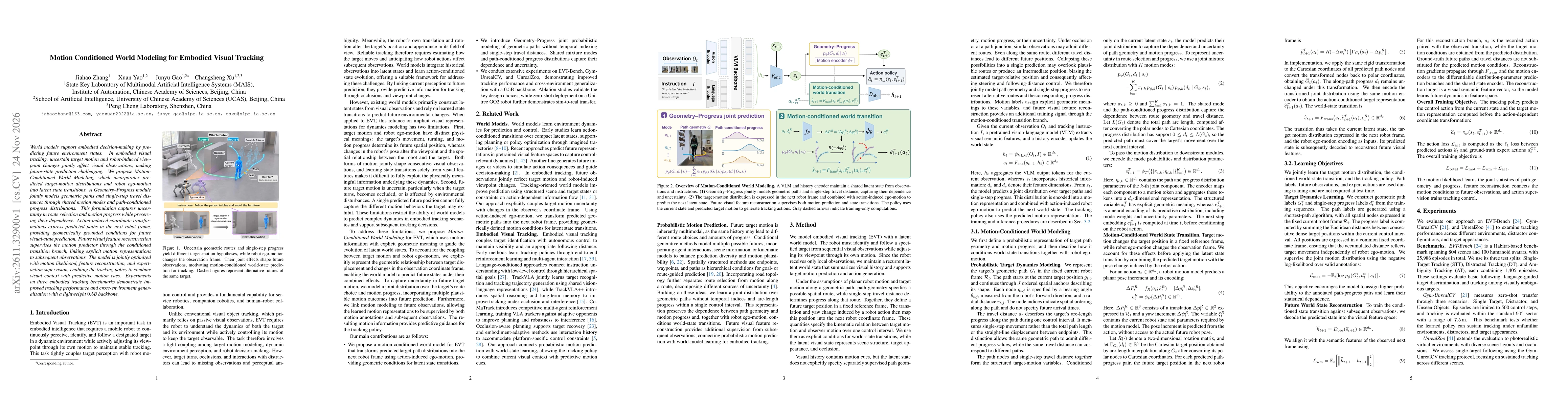
World models support embodied decision-making by predicting future environment states. In embodied visual tracking, uncertain target motion and robot-induced viewpoint changes jointly affect visual observations, making future-state prediction challenging. We propose Motion-Conditioned World Modeling, which incorporates predicted target-motion distributions and robot ego-motion into latent state transitions. A Geometry--Progress module jointly models geometric paths and single-step travel distances through shared motion modes and path-conditioned progress distributions. This formulation captures uncertainty in route selection and motion progress while preserving their dependence. Action-induced coordinate transformations express predicted paths in the next robot frame, providing geometrically grounded conditions for future visual-state prediction. Future visual feature reconstruction supervises the motion predictor through the conditioned transition branch, linking explicit motion representations to subsequent observations. The model is jointly optimized with motion likelihood, feature reconstruction, and expert-action supervision, enabling the tracking policy to combine visual context with predictive motion cues.Experiments on three embodied tracking benchmarks demonstrate improved tracking performance and cross-environment generalization with a lightweight $0.5$B backbone.
AI Key Findings
Get AI-generated insights about this paper's methodology, results, significance, and more — available when analysis has been generated.
Discussion 0