Multiscale Renormalization of Weighted Networks
Abstract
Recent progress in network renormalization has identified various ways to transform network representations consistently across resolution levels. In particular, the renormalization flow describing how random graph models transform under node aggregation has identified a fixed point corresponding to an aggregation-invariant model that preserves the form of the connection probability across arbitrary scales. While this probabilistic multiscale approach has successfully been used to model real-world networks, construct latent-space node embeddings, and reconstruct finer-grained versions of aggregate network data in a principled resolution-invariant way, it has so far been restricted to binary graphs. Here we reformulate multiscale network renormalization for weighted random graphs. Via a generating-function approach, we identify a weighted multiscale model whose full probability law, encoding both link creation and weight assignment, has an invariant compound-Poisson form under arbitrary node aggregation. The renormalization rules that transform parameters across aggregation levels allow the ensemble to be calibrated at one level and applied at another, enabling consistent modeling and reconstruction of weighted networks across arbitrary scales.
Analysis
AI-generated · verify against the original paper
Generated Jan 1, 0001ResultsWhat the authors found
- An invariant weighted multiscale model (wMSM) with a compound‑Poisson probability law is identified, remaining unchanged under node aggregation.
- The model cleanly separates the binary projection (global density parameter δ) from weight scaling (global weight parameter ρ), allowing independent calibration.
- Closure under coarse‑graining is proved: sums of independent compound‑Poisson variables retain the same form, ensuring scale‑invariant parameter transformation.
- Calibration of δ and ρ at any aggregation level yields consistent predictions of link probabilities and expected strengths at finer levels.
LimitationsWhere the findings need caution
- The formulation assumes non‑negative integer weights and independent dyadic connections, which may not capture correlated weight patterns in some real systems.
- Handling of diagonal dyads (self‑loops) requires special conventions; removing them breaks the exact strength reproduction unless the global normalization is adjusted.
MethodologyHow the work was done
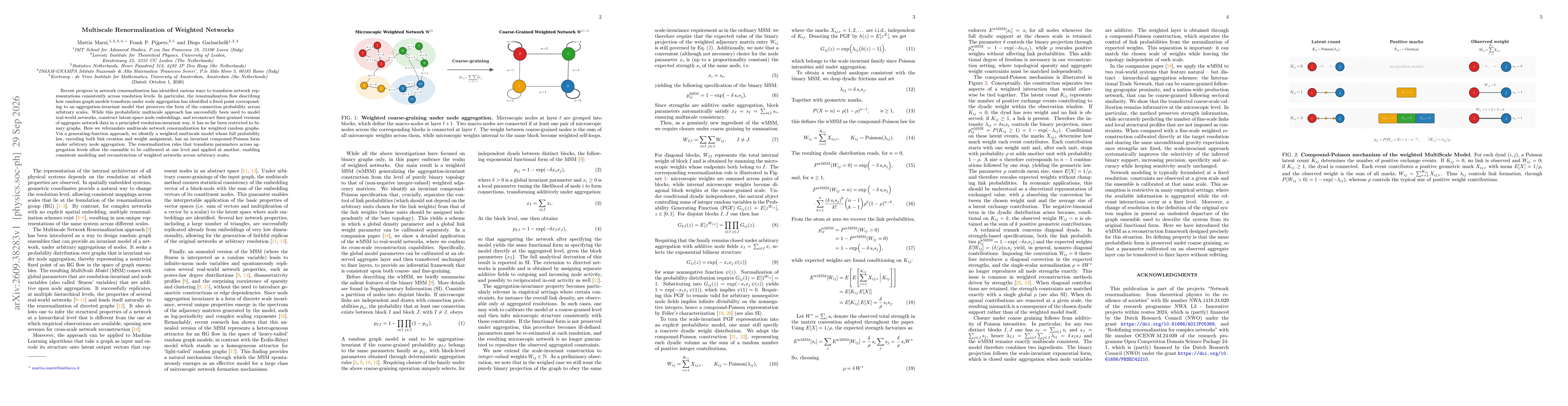
We reformulate multiscale network renormalization for weighted random graphs using a generating‑function approach, defining a weighted multiscale model (wMSM) as a compound‑Poisson process with independent Poisson dyadic intensities λij and geometric marks Xij,r. The model separates link‑creation probabilities (pij=1−exp(−λij)) from weight magnitudes (E[Wij]=λij/ρ) and derives renormalization rules that preserve the compound‑Poisson form under arbitrary node aggregation.
SignificanceWhy the work matters
The work extends multiscale network renormalization from binary to weighted graphs, providing a principled framework for consistent modeling, embedding, and cross‑scale reconstruction of weighted networks.
Technical contributionsWhat the work introduces
Derivation of a weighted multiscale model (wMSM) based on a compound‑Poisson construction, explicit renormalization equations for λij and ρ across aggregation levels, and analytical proof of scale invariance and closure under coarse‑graining.
NoveltyHow it differs from prior work
First probabilistic multiscale renormalization framework that accommodates weighted edges, introducing an invariant compound‑Poisson specification that separates link density from weight magnitude.
Future workQuestions that remain
- Apply the weighted multiscale model to a broader set of empirical weighted networks and evaluate reconstruction performance.
- Explore alternative mark distributions beyond the geometric choice to model different weight heterogeneities.
- Extend the framework to directed, temporal, or multilayer weighted networks.
Discussion 0