Muon Imaging for Illicit Cargo Detection: A Simulation-Based Study
Summary generation failed
Abstract
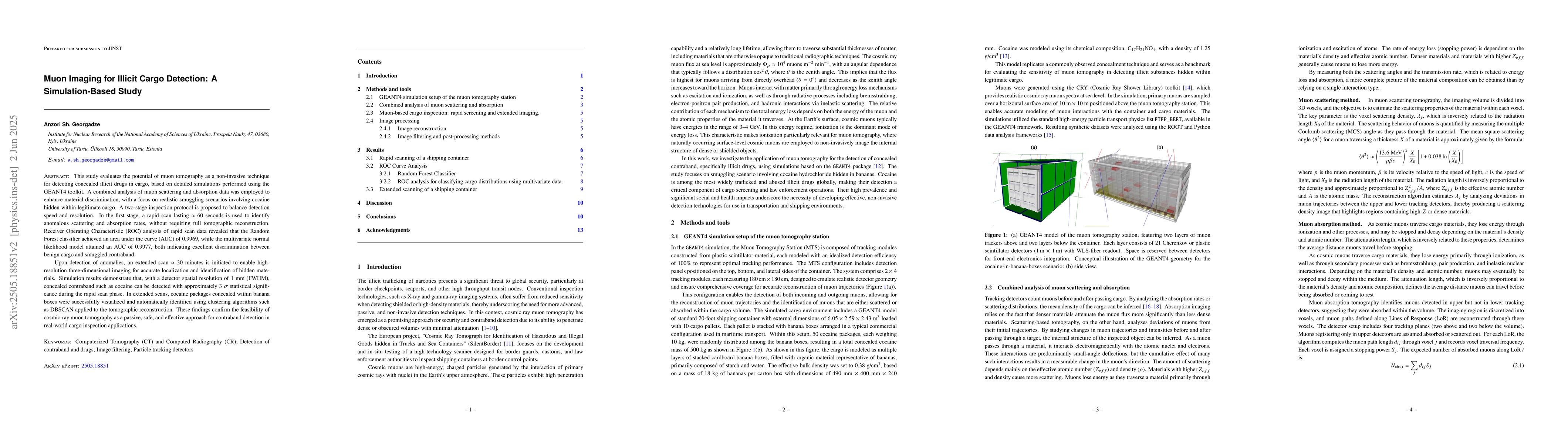
This study evaluates the potential of muon tomography as a non-invasive technique for detecting concealed illicit drugs in cargo, based on detailed simulations performed using the GEANT4 toolkit. A combined analysis of muon scattering and absorption data was employed to enhance material discrimination, with a focus on realistic smuggling scenarios involving cocaine hidden within legitimate cargo. A two-stage inspection protocol is proposed to balance detection speed and resolution. In the first stage, a rapid scan lasting 60 seconds is used to identify anomalous scattering and absorption rates, without requiring full tomographic reconstruction. Upon detection of anomalies, an extended scan ~30 minutes is initiated to enable high-resolution three-dimensional imaging for accurate localization and identification of hidden materials. Simulation results demonstrate that, with a detector spatial resolution of 1 mm (FWHM), concealed contraband such as cocaine can be detected with approximately 3 sigma statistical significance during the rapid scan phase. In extended scans, cocaine packages concealed within banana boxes were successfully visualized and automatically identified using clustering algorithms such as DBSCAN applied to the tomographic reconstruction. These findings confirm the feasibility of cosmic-ray muon tomography as a passive, safe, and effective approach for contraband detection in real-world cargo inspection applications.
Analysis
AI-generated · verify against the original paper
Generated Jun 7, 2025ResultsWhat the authors found
- A two-stage inspection protocol was proposed for balancing detection speed and resolution.
- Rapid scans (60 seconds) identified anomalous scattering and absorption rates with 3 sigma statistical significance.
- Extended scans (~30 minutes) enabled high-resolution 3D imaging for accurate localization and identification of hidden materials like cocaine concealed within legitimate cargo.
LimitationsWhere the findings need caution
- The study is based on simulations and has not been validated with real-world experimental data.
- The proposed method's performance may vary depending on the actual cargo composition and density.
MethodologyHow the work was done
The research utilized detailed simulations with the GEANT4 toolkit to evaluate muon tomography for detecting illicit drugs in cargo. It combined muon scattering and absorption data analysis for improved material discrimination, focusing on realistic smuggling scenarios.
SignificanceWhy the work matters
This study confirms the feasibility of cosmic-ray muon tomography as a non-invasive, safe, and effective method for contraband detection in real-world cargo inspection applications.
Technical contributionsWhat the work introduces
The research presents an advanced simulation-based approach for muon tomography, enhancing material discrimination through combined scattering and absorption data analysis.
NoveltyHow it differs from prior work
This work introduces a two-stage inspection protocol optimized for speed and resolution, demonstrating successful identification of concealed contraband using clustering algorithms on tomographic reconstructions.
Future workQuestions that remain
- Further research should validate the simulation results with practical experiments.
- Investigate the method's applicability to a broader range of illicit materials and cargo types.
Discussion 0