This research introduces Net2Vis, a system that automates the generation of publication-ready visualizations for convolutional neural network (CNN) architectures. By translating Keras-specified networks into standardized visualizations, the approach aims to reduce manual effort, errors, and ambiguities typically associated with handcrafted visualizations. The system is based on a visual grammar derived from analyzing CNN figures in top computer vision conference papers, ensuring consistency and clarity.
Abstract
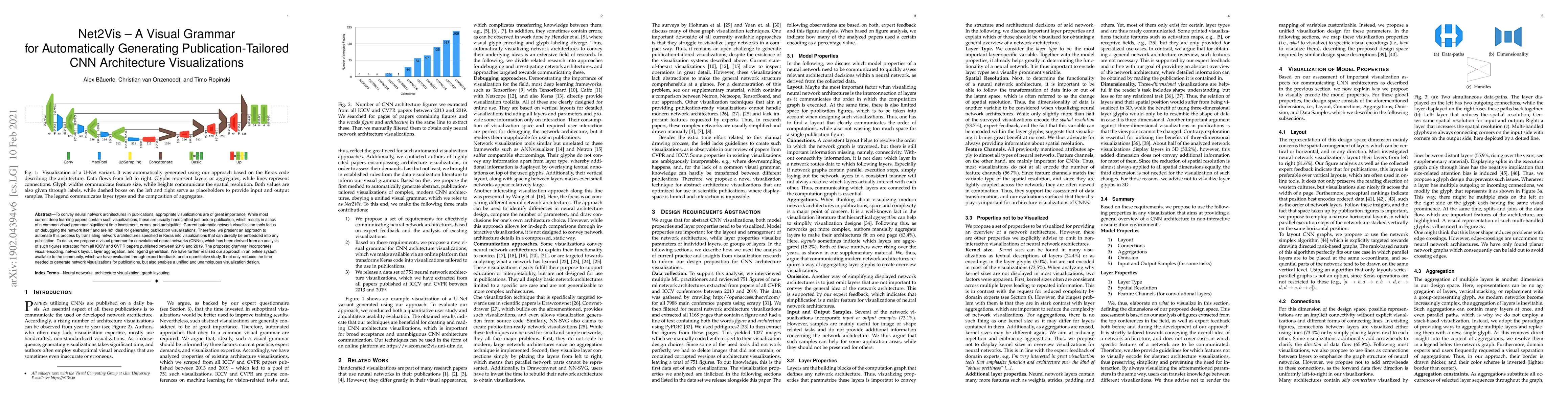
To convey neural network architectures in publications, appropriate visualizations are of great importance. While most current deep learning papers contain such visualizations, these are usually handcrafted just before publication, which results in a lack of a common visual grammar, significant time investment, errors, and ambiguities. Current automatic network visualization tools focus on debugging the network itself and are not ideal for generating publication visualizations. Therefore, we present an approach to automate this process by translating network architectures specified in Keras into visualizations that can directly be embedded into any publication. To do so, we propose a visual grammar for convolutional neural networks (CNNs), which has been derived from an analysis of such figures extracted from all ICCV and CVPR papers published between 2013 and 2019. The proposed grammar incorporates visual encoding, network layout, layer aggregation, and legend generation. We have further realized our approach in an online system available to the community, which we have evaluated through expert feedback, and a quantitative study. It not only reduces the time needed to generate network visualizations for publications, but also enables a unified and unambiguous visualization design.
AI Key Findings
Get AI-generated insights about this paper's methodology, results, significance, and more — available when analysis has been generated.
Discussion 0