Network Intrusion Detection Adaptability under Spurious Labels: A Noise-Aware Few-Shot Class-Incremental Learning Framework
Abstract
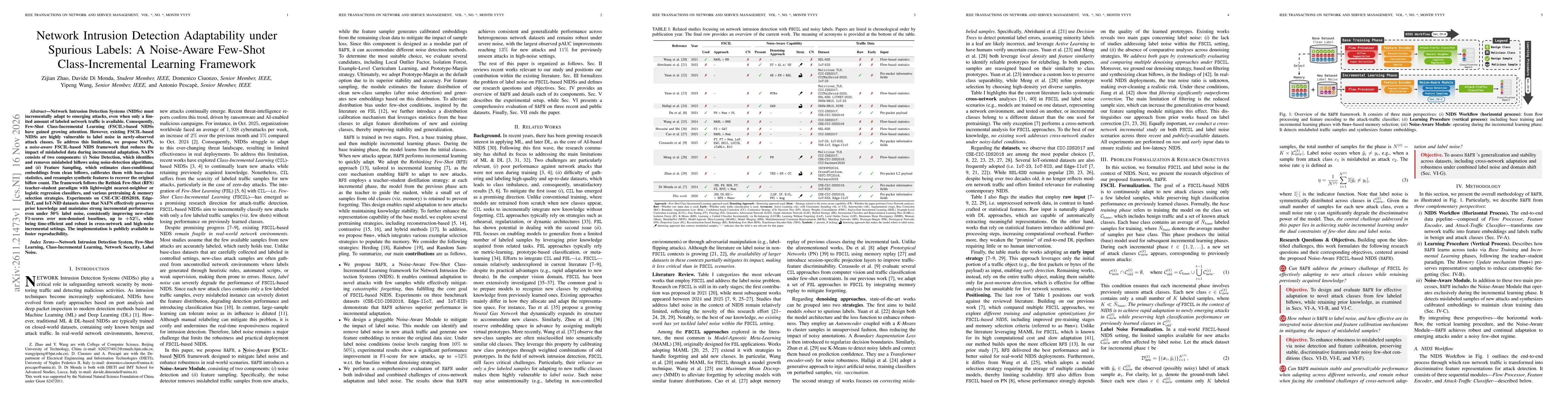
Network Intrusion Detection Systems (NIDSs) must incrementally adapt to emerging attacks, even when only a limited amount of labeled network traffic is available. Consequently, Few-Shot Class-Incremental Learning (FSCIL)-based NIDSs have gained growing attention. However, existing FSCIL-based NIDSs are highly vulnerable to label noise in newly-observed attack classes. To address this limitation, we propose NAFN, a noise-aware FSCIL-based NIDS framework that reduces the impact of mislabeled data during incremental adaptation. NAFN consists of two components: (i) Noise Detection, which identifies and removes mislabeled biflows using noise-detection algorithms, and (ii) Feature Sampling, which estimates class-conditional embeddings from clean biflows, calibrates them with base-class statistics, and resamples synthetic features to recover the original biflow count. The framework follows the Rethink Few-Shot (RFS) teacher-student paradigm with lightweight nearest-neighbor or logistic regression classifiers, and various pretraining & memory selection strategies. Experiments on CSE-CIC-IDS2018, Edge-IIoT, and IoT-NID datasets show that NAFN effectively preserves prior knowledge and maintains strong incremental performance even under 50% label noise, consistently improving new-class F1-scores over non-denoised baselines, up to +52%, while being time-efficient and robust in cross-network and high-noise incremental settings. The implementation is publicly available to foster reproducibility.
Analysis
AI-generated · verify against the original paper
Generated Jan 1, 0001ResultsWhat the authors found
- Under up to 50% label noise, NAFN improves new‑class F1‑scores over non‑denoised baselines by up to +52%.
- Cross‑network and high‑noise incremental experiments show consistent pAUC gains of up to 13% for new attacks and 11% for previously unseen attacks.
- The framework maintains prior knowledge, remains time‑efficient, and demonstrates robustness across three benchmark datasets (CSE‑CIC‑IDS2018, Edge‑IIoT, IoT‑NID).
MethodologyHow the work was done
NAFN is a noise-aware few-shot class-incremental learning framework for NIDS that combines a Noise Detection component (using algorithms such as Prototype‑Margin) to filter mislabeled biflows and a Feature Sampling component that estimates clean class‑conditional embeddings, calibrates them with base‑class statistics, and resamples synthetic features to restore the original data distribution. The system follows the Rethink Few‑Shot (RFS) teacher‑student paradigm with lightweight nearest‑neighbor or logistic‑regression classifiers and employs various pretraining and memory‑selection strategies (e.g., reconstruction‑based, contrastive, hybrid, Herding, Rainbow, Random).
SignificanceWhy the work matters
NAFN enables practical deployment of NIDS that can continuously adapt to emerging attacks with only a few labeled samples while being resilient to substantial label noise, addressing a critical barrier to real‑world incremental intrusion detection.
Technical contributionsWhat the work introduces
Introduction of a modular Noise‑Aware Module comprising (i) a prototype‑margin based noise detector and (ii) a distribution‑calibrated feature sampler that generates synthetic embeddings to compensate for removed noisy samples, integrated within a few‑shot class‑incremental learning pipeline for NIDS.
NoveltyHow it differs from prior work
First FSCIL‑based NIDS framework that explicitly mitigates label noise through combined noise detection and calibrated feature resampling, achieving strong incremental performance without extensive data cleaning.
Discussion 0