This paper explores non-deterministic self-assembly with asymmetric interactions, demonstrating that such interactions can limit cluster growth and enable tuning of cluster sizes through particle abundance. The findings have implications for bioengineering and understanding protein aggregation diseases.
Abstract
We investigate general properties of non-deterministic self-assembly with asymmetric interactions, using a computational model and DNA tile assembly experiments. By contrasting symmetric and asymmetric interactions we show that the latter can lead to self-limiting cluster growth. Furthermore, by adjusting the relative abundance of self-assembly particles in a two-particle mixture, we are able to tune the final sizes of these clusters. We show that this is a fundamental property of asymmetric interactions, which has potential applications in bioengineering, and provides new insights into the study of diseases caused by protein aggregation.
Analysis
AI-generated · verify against the original paper
Generated Sep 7, 2025ResultsWhat the authors found
- Asymmetric interactions lead to self-limiting cluster growth, unlike symmetric interactions which result in infinite cluster growth.
- By adjusting the relative abundance of self-assembly particles in a two-particle mixture, the final sizes of clusters can be tuned.
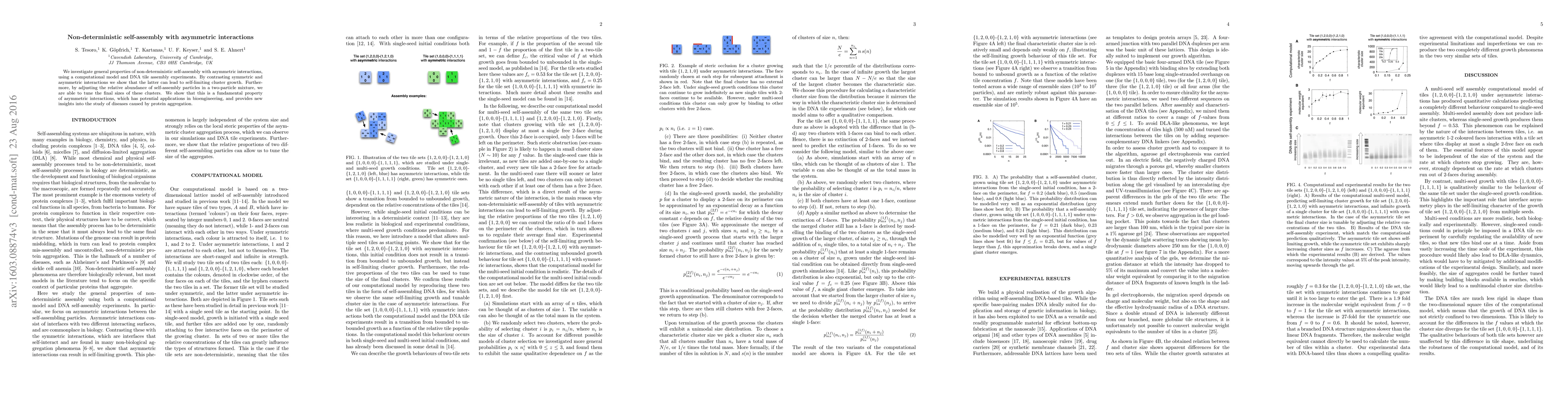
- The self-limiting growth behavior of asymmetric tile sets was demonstrated both computationally and experimentally using DNA tiles.
LimitationsWhere the findings need caution
- The study was limited to specific tile sets and did not explore a wide range of interaction types or system sizes.
- Experimental limitations and imperfections might affect the accuracy of cluster size determination.
MethodologyHow the work was done
The study uses a computational model and DNA tile assembly experiments to investigate non-deterministic self-assembly with asymmetric interactions, contrasting it with symmetric interactions.
SignificanceWhy the work matters
This research provides insights into protein aggregation diseases and has potential applications in bioengineering, offering a new perspective on controlling self-assembly processes.
Technical contributionsWhat the work introduces
The paper presents a computational model and experimental validation of non-deterministic self-assembly with asymmetric interactions, demonstrating tunable self-limiting cluster growth.
NoveltyHow it differs from prior work
The work introduces a novel approach to controlling self-assembly processes through asymmetric interactions, providing a significant departure from previous research focused on symmetric interactions.
Future workQuestions that remain
- Further investigation of other tile sets under multi-seed conditions could be beneficial.
- Exploring additional asymmetric interaction models and their effects on self-assembly could expand the understanding of this phenomenon.
Discussion 0