Abstract
We survey aspects of nonlinear Fourier series as presented in the 2026 Brouwer lecture by the second author. The fast nonlinear Fourier expansion mentioned in the lecture is further elaborated in joint work with the first author.
Analysis
AI-generated · verify against the original paper
Generated Jan 1, 0001ResultsWhat the authors found
- A fast nonlinear Fourier expansion is detailed and extended beyond the original Brouwer lecture.
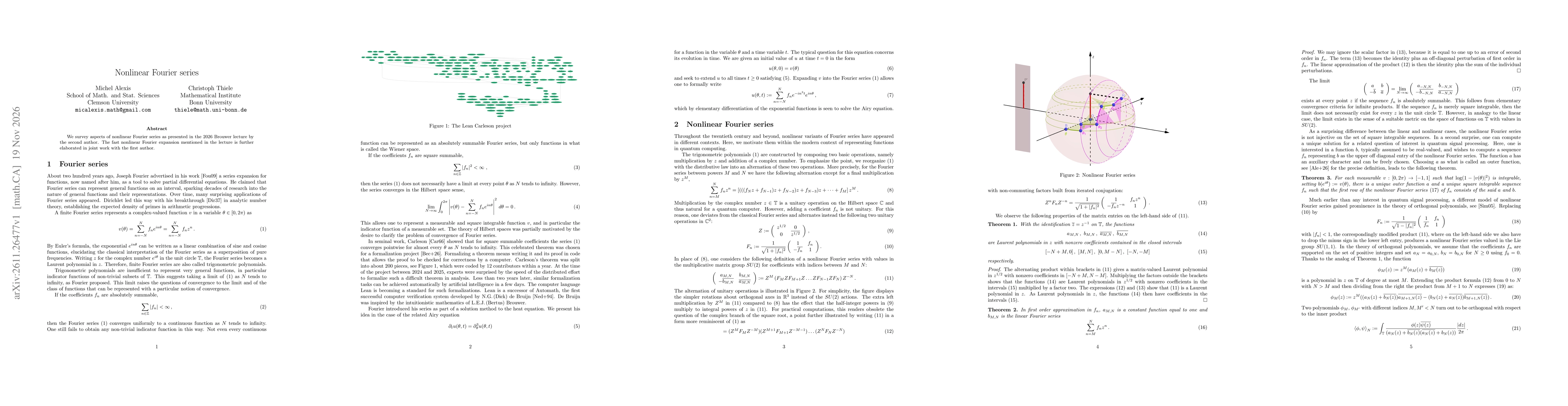
- The Carleson theorem for Fourier series convergence was formalized in Lean, demonstrating the feasibility of computer-verified proofs for deep analysis results.
- Connections to quantum signal processing and SU(2)-valued nonlinear Fourier series are highlighted, showing practical applications of the theory.
LimitationsWhere the findings need caution
- The survey focuses primarily on existing results and does not provide new convergence theorems beyond the formalized Carleson theorem.
- The fast expansion is demonstrated only for specific cases (e.g., SU(2)-valued functions) and may not generalize to all nonlinear Fourier contexts.
MethodologyHow the work was done
The paper surveys existing literature on nonlinear Fourier series and presents an elaboration of a fast nonlinear Fourier expansion through joint work, combining theoretical analysis with computational formalization using the Lean proof assistant.
SignificanceWhy the work matters
By bridging classical harmonic analysis with modern formal verification and computational techniques, the work advances both the theoretical understanding of nonlinear Fourier series and its applicability to quantum signal processing.
Technical contributionsWhat the work introduces
Implementation of the fast nonlinear Fourier expansion algorithm and its integration with Lean for formal verification of convergence theorems.
NoveltyHow it differs from prior work
First comprehensive formalization of Carleson's convergence theorem for Fourier series in Lean, coupled with a newly elaborated fast nonlinear Fourier expansion.
Future workQuestions that remain
- Extending the fast nonlinear Fourier expansion to broader classes of functions and higher-dimensional groups.
- Further automation of formal proof generation for nonlinear Fourier analysis results.
Discussion 0