NOTREKS: Marginal Independence in Score-based Structure Learning
Abstract
Score-based structure learning estimates causal graphs by optimizing a data-dependent objective over structural equation models. We study how prior knowledge that selected pairs of variables are marginally independent can be incorporated into such causal discovery methods. Under faithfulness, marginally independent pairs cannot be connected by a trek, so the knowledge becomes a graphical no-trek constraint, which we call NOTREKS information. We introduce a power-series trek (PSTrek) penalty for gradient-based optimization and a trek constraint for order-based search, and we analyze why such information helps in finite samples and how it restricts the search space. Our numerical experiments illustrate to what extent NOTREKS information helps in causal discovery. In particular, using synthetic benchmarks with oracle NOTREKS information, we show that these constraints can improve both structural recovery and adjustment-based effect identification.
Analysis
AI-generated · verify against the original paper
Generated Jan 1, 0001ResultsWhat the authors found
- Synthetic benchmarks with oracle NOTREKS information improve both structural recovery and adjustment‑based effect identification.
- PSTrek regularization yields lower structural‑recovery error and shorter runtime compared to the vanilla baseline.
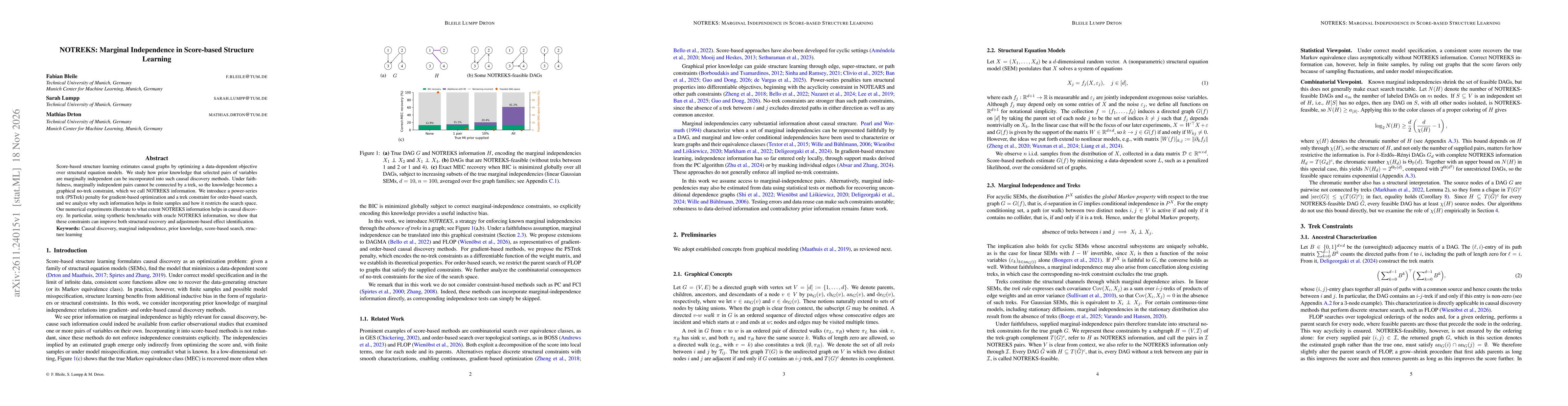
- Exact MEC recovery increases as more true marginal‑independence constraints are incorporated in the score minimization.
LimitationsWhere the findings need caution
- The study does not consider constraint‑based methods such as PC or FCI.
- Increasing the amount of supplied NOTREKS information does not always lead to a consistent improvement in structural recovery.
MethodologyHow the work was done
The paper introduces the NOTREKS framework that encodes marginal independence as no‑trek constraints, implements a power‑series trek (PSTrek) penalty for gradient‑based optimization (extending DAGMA) and a trek constraint for order‑based search (extending FLOP), and analyzes the resulting reduction in search space.
SignificanceWhy the work matters
Incorporating marginal‑independence knowledge as no‑trek constraints provides a useful inductive bias that enhances causal discovery performance, especially in finite‑sample regimes.
Technical contributionsWhat the work introduces
A differentiable PSTrek penalty that enforces no‑trek constraints in gradient‑based score optimization and a combinatorial trek constraint for order‑based search, together with theoretical analysis of their impact on the search space.
NoveltyHow it differs from prior work
First work to translate marginal independence into graphical no‑trek constraints (NOTREKS) and integrate them into score‑based causal structure learning via a novel PSTrek regularizer and order‑based trek constraints.
Discussion 0