Optimizing Electric Vehicles Charging using Large Language Models and Graph Neural Networks
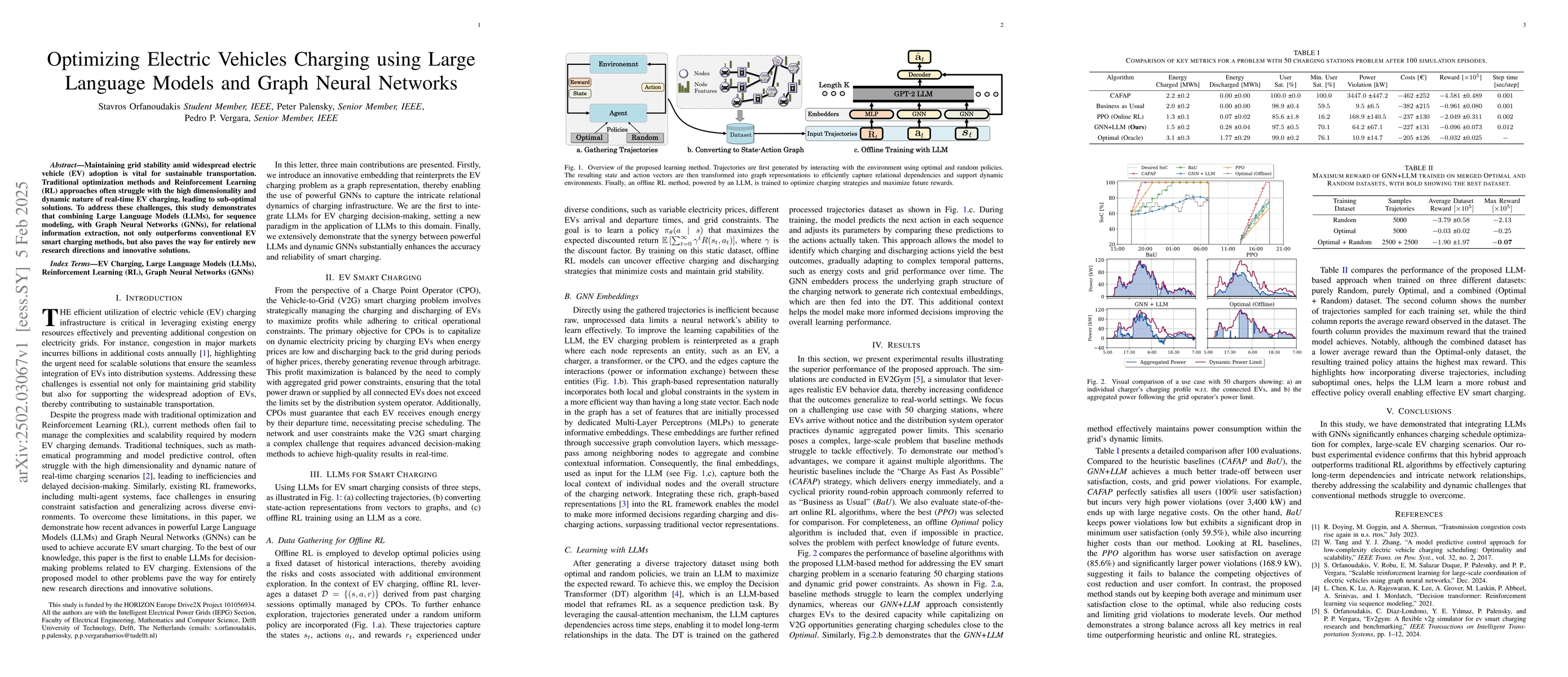
This study combines Large Language Models (LLMs) and Graph Neural Networks (GNNs) to optimize electric vehicle charging, achieving better grid stability than traditional methods and paving the way for innovative solutions. The integration of LLMs for sequence modeling and GNNs for relational information extraction addresses the high dimensionality and dynamic nature of EV charging.
Abstract
Maintaining grid stability amid widespread electric vehicle (EV) adoption is vital for sustainable transportation. Traditional optimization methods and Reinforcement Learning (RL) approaches often struggle with the high dimensionality and dynamic nature of real-time EV charging, leading to sub-optimal solutions. To address these challenges, this study demonstrates that combining Large Language Models (LLMs), for sequence modeling, with Graph Neural Networks (GNNs), for relational information extraction, not only outperforms conventional EV smart charging methods, but also paves the way for entirely new research directions and innovative solutions.
Analysis
AI-generated · verify against the original paper
Generated Jun 11, 2025ResultsWhat the authors found
- The proposed GNN+LLM approach significantly outperforms baseline heuristic methods (CAFAP, BaU) and state-of-the-art online RL algorithms (PPO) in terms of user satisfaction, costs, and grid power violations.
- Experiments in EV2Gym simulator demonstrate that the GNN+LLM method effectively maintains power consumption within dynamic grid limits, achieving a better trade-off between user satisfaction, costs, and grid power violations compared to other methods.
- The trained LLM, when exposed to diverse trajectories (including suboptimal ones), learns a more robust and effective policy for EV smart charging, achieving higher maximum rewards than when trained on optimal-only datasets.
LimitationsWhere the findings need caution
- The study was conducted using a simulator (EV2Gym), so real-world performance and generalizability need further validation.
- The proposed method requires substantial computational resources for training LLMs and processing graph data.
MethodologyHow the work was done
The research combines Large Language Models (LLMs) and Graph Neural Networks (GNNs) to optimize electric vehicle (EV) charging, addressing the challenges of high dimensionality and dynamic nature of real-time EV charging scenarios. It introduces an innovative graph representation of the EV charging problem and integrates LLMs for decision-making, outperforming traditional methods and RL frameworks.
SignificanceWhy the work matters
This research is significant as it presents a novel hybrid approach using LLMs and GNNs to optimize EV charging schedules, addressing the scalability and dynamic challenges faced by traditional methods. The method has the potential to contribute to sustainable transportation by maintaining grid stability amid widespread EV adoption.
Technical contributionsWhat the work introduces
The paper introduces a novel hybrid method that integrates LLMs and GNNs for EV smart charging, effectively capturing long-term dependencies and intricate network relationships, thereby overcoming the limitations of traditional RL algorithms.
NoveltyHow it differs from prior work
This work is novel as it is the first to leverage LLMs for EV charging decision-making problems, paving the way for new research directions and innovative solutions in the field.
Future workQuestions that remain
- Investigate the applicability and performance of the proposed method in real-world scenarios with diverse EV fleets and charging infrastructures.
- Explore methods to reduce computational complexity and resource requirements for deploying the approach in practical settings.
Discussion 0