OSD-JSCC: Neural Joint Source-Channel Coding with One-Step Diffusion
Abstract
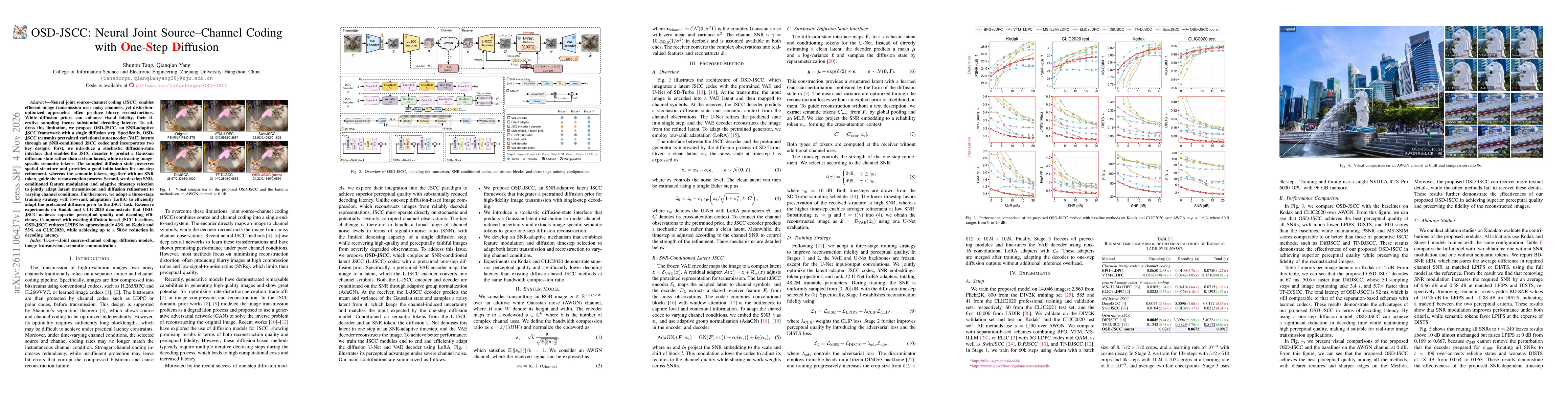
Neural joint source-channel coding (JSCC) enables efficient image transmission over noisy channels, yet distortion-optimized approaches often produce blurry reconstructions. While diffusion priors can enhance visual fidelity, their iterative sampling incurs substantial decoding latency. To address this limitation, we propose OSD-JSCC, an SNR-adaptive JSCC framework with a single diffusion step. Specifically, OSD-JSCC transmits pretrained variational autoencoder (VAE) latents through an SNR-conditioned JSCC codec and incorporates two key designs. First, we introduce a stochastic diffusion-state interface that enables the JSCC decoder to predict a Gaussian diffusion state rather than a clean latent, while extracting image-specific semantic tokens. The sampled diffusion state preserves spatial structure and provides a good initialization for one-step refinement, whereas the semantic tokens, together with an SNR token, guide the reconstruction process. Second, we develop SNR-conditioned feature modulation and adaptive timestep selection to jointly adapt latent transmission and diffusion refinement to varying channel conditions. Furthermore, we adopt a three-stage training strategy with low-rank adaptation (LoRA) to efficiently adapt the pretrained diffusion prior to the JSCC task. Extensive experiments on Kodak and CLIC2020 demonstrate that OSD-JSCC achieves superior perceptual quality and decoding efficiency. Compared with existing diffusion-based JSCC baselines, OSD-JSCC reduces LPIPS by approximately 43% on Kodak and 53% on CLIC2020, while achieving up to a 50.6$\times$ reduction in decoding latency.
Analysis
AI-generated · verify against the original paper
Generated Jan 1, 0001ResultsWhat the authors found
- Reduces LPIPS by ~43% on Kodak and ~53% on CLIC2020 compared to diffusion‑based JSCC baselines.
- Achieves up to 50.6× reduction in decoding latency (67 ms vs 3.4 s for DiffJSCC).
- Consistently superior perceptual quality across all SNRs with lower LPIPS, DISTS, and FID scores while maintaining comparable PSNR and MS‑SSIM.
LimitationsWhere the findings need caution
- Ablation shows that removing SNR modulation degrades performance, increasing required SNR by 0.66 dB (LPIPS) and 0.58 dB (DISTS).
- Excluding semantic tokens leads to trade‑offs, improving DISTS but worsening LPIPS, indicating dependence on token design.
MethodologyHow the work was done
OSD-JSCC combines a pretrained VAE latent encoder with an SNR‑conditioned JSCC codec that predicts a Gaussian diffusion state and extracts image‑specific semantic tokens. It employs SNR‑conditioned feature modulation and adaptive timestep selection to jointly adapt latent transmission and one‑step diffusion refinement, and uses a three‑stage training strategy with low‑rank adaptation (LoRA) to efficiently adapt the diffusion prior to the JSCC task.
SignificanceWhy the work matters
The approach enables high‑fidelity image transmission over noisy channels with real‑time decoding speed, addressing the latency bottleneck of iterative diffusion methods and advancing practical neural JSCC systems.
Technical contributionsWhat the work introduces
Introduces a stochastic diffusion‑state interface that lets the JSCC decoder output a Gaussian latent distribution and extracts semantic tokens, coupled with SNR‑conditioned feature modulation and adaptive timestep selection, all integrated with LoRA‑based adaptation of a pretrained diffusion prior.
NoveltyHow it differs from prior work
First JSCC framework to achieve high‑quality image reconstruction with a single diffusion step by jointly adapting latent transmission and diffusion refinement to channel SNR.
Discussion 0