PACD: Provenance-Aware Consensus Decoding for Mitigating Cross-Modal Hallucinations in Omnimodal Large Language Models
Abstract
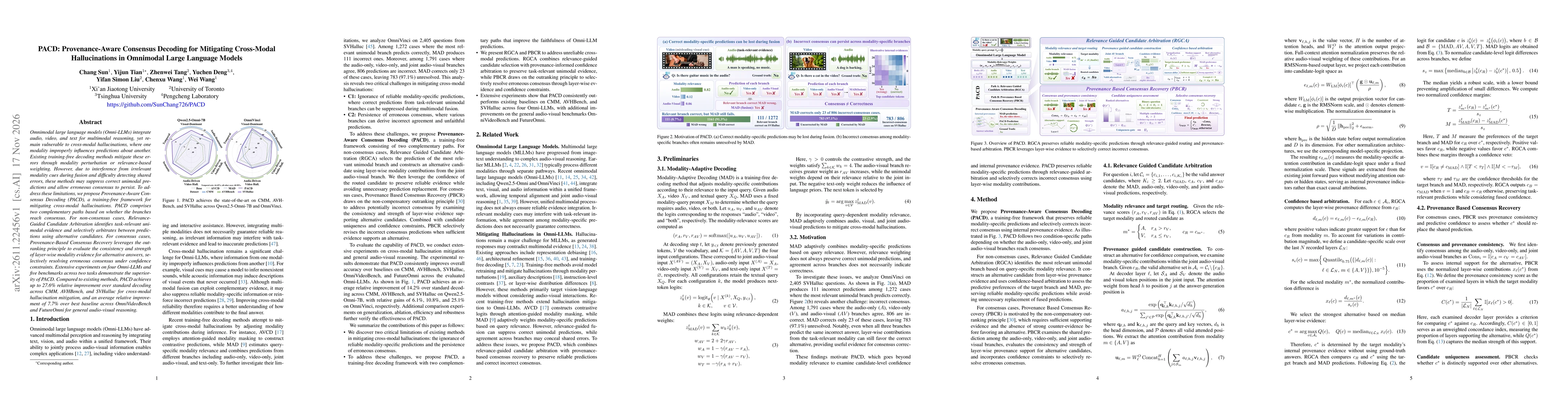
Omnimodal large language models (Omni-LLMs) integrate audio, video, and text for multimodal reasoning, yet remain vulnerable to cross-modal hallucinations, where one modality improperly influences predictions about another. Existing training-free decoding methods mitigate these errors through modality perturbation or relevance-based weighting. However, due to interference from irrelevant modality cues during fusion and difficulty detecting shared errors, these methods may suppress correct unimodal predictions and allow erroneous consensus to persist. To address these limitations, we propose Provenance-Aware Consensus Decoding (PACD), a training-free framework for mitigating cross-modal hallucinations. PACD comprises two complementary paths based on whether the branches reach consensus. For non-consensus cases, Relevance-Guided Candidate Arbitration identifies task-relevant unimodal evidence and selectively arbitrates between predictions using alternative candidates. For consensus cases, Provenance-Based Consensus Recovery leverages the outranking principle to evaluate the consistency and strength of layer-wise modality evidence for alternative answers, selectively resolving erroneous consensus under confidence constraints. Extensive experiments on four Omni-LLMs and five benchmarks across two tasks demonstrate the superiority of PACD. Compared to existing methods, PACD achieves up to 27.6% relative improvement over standard decoding across CMM, AVHBench, and SVHalluc for cross-modal hallucination mitigation, and an average relative improvement of 7.7% over best baseline across OmniVideoBench and FutureOmni for general audio-visual reasoning.
Analysis
AI-generated · verify against the original paper
Generated Jan 1, 0001ResultsWhat the authors found
- PACD achieves up to 27.6% relative improvement over standard decoding on CMM, AVHBench, and SVHalluc for cross‑modal hallucination mitigation.
- Across four Omni‑LLMs and five benchmarks, PACD yields an average relative improvement of 7.7% over the best baseline on OmniVideoBench and FutureOmni for general audio‑visual reasoning.
- On the three hallucination benchmarks, PACD attains an average relative gain of 14.2% over standard decoding, with specific gains of 6.1% (Qwen2.5‑Omni‑7B), 10.8% (OmniVinci), and 25.1% (OmniVinci) on individual datasets.
MethodologyHow the work was done
PACD is a training‑free decoding framework that handles cross‑modal hallucinations via two complementary paths: Relevance‑Guided Candidate Arbitration (RGCA) for non‑consensus cases, which selects the most relevant unimodal prediction and constructs alternative candidates using layer‑wise modality contributions; and Provenance‑Based Consensus Recovery (PBCR) for consensus cases, which applies an outranking principle to evaluate consistency and strength of layer‑wise evidence for alternative answers, revising erroneous consensus under confidence constraints.
SignificanceWhy the work matters
The proposed framework substantially enhances the faithfulness of Omni‑LLM predictions by preserving reliable unimodal evidence and correcting erroneous consensus, thereby addressing critical challenges of modality interference and persistent hallucinations in multimodal reasoning systems.
Technical contributionsWhat the work introduces
Introduces a novel, training‑free decoding approach that integrates relevance‑guided arbitration with provenance‑based consensus recovery, enabling selective preservation of task‑relevant unimodal predictions and systematic correction of false consensus in omnimodal large language models.
NoveltyHow it differs from prior work
PACD uniquely combines provenance‑aware evidence analysis with an outranking principle to both arbitrate between competing unimodal candidates and recover correct answers from incorrect consensus, a capability not present in prior training‑free decoding methods.
Discussion 0