$p\bar{p} \to \Lambda_c \bar{\Lambda}_c$ within the generalized parton picture - first results
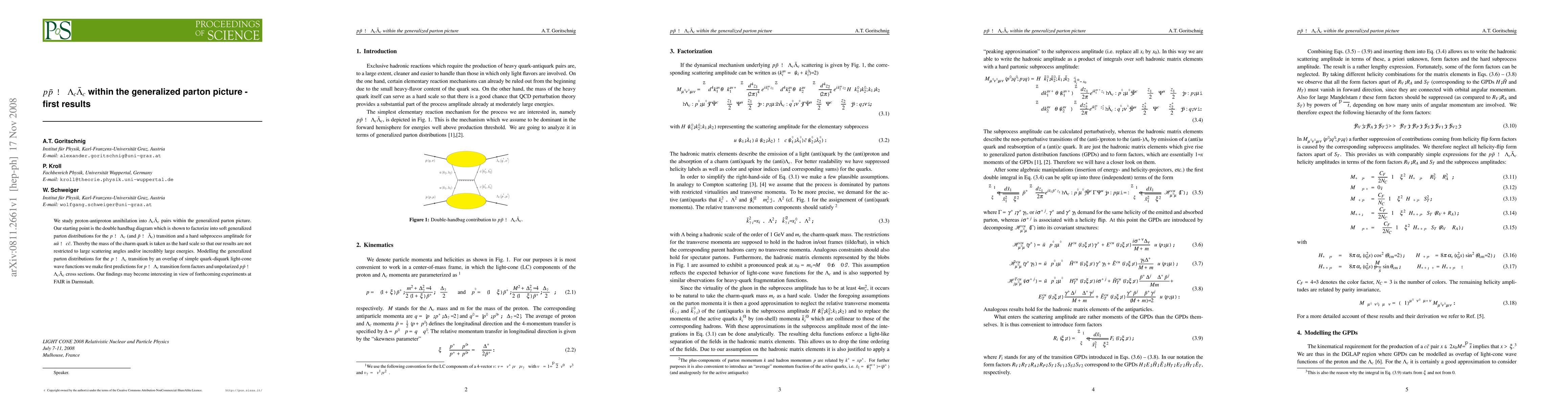
This paper investigates proton-antiproton annihilation into $\Lambda_c \bar{\Lambda}_c$ pairs using the generalized parton picture, factorizing the double handbag diagram into soft generalized parton distributions and a hard subprocess. Initial predictions for transition form factors and cross sections are made, potentially relevant for future experiments at FAIR.
Abstract
We study proton-antiproton annihilation into $\Lambda_c \bar{\Lambda}_c$ pairs within the generalized parton picture. Our starting point is the double handbag diagram which is shown to factorize into soft generalized parton distributions for the $p \to \Lambda_c$ (and $\bar{p} \to \bar{\Lambda}_c$) transition and a hard subprocess amplitude for $u \bar{u} \to c \bar{c}$. Thereby the mass of the charm quark is taken as the hard scale so that our results are not restricted to large scattering angles and/or incredibly large energies. Modelling the generalized parton distributions for the $p\to \Lambda_c$ transition by an overlap of simple quark-diquark light-cone wave functions we make first predictions for $p\to \Lambda_c$ transition form factors and unpolarized $p\bar{p} \to \Lambda_c \bar{\Lambda}_c$ cross sections. Our findings may become interesting in view of forthcoming experiments at FAIR in Darmstadt.
AI Key Findings
Get AI-generated insights about this paper's methodology, results, significance, and more — available when analysis has been generated.
Discussion 0