PINNs Failure Modes are Overfitting
Abstract
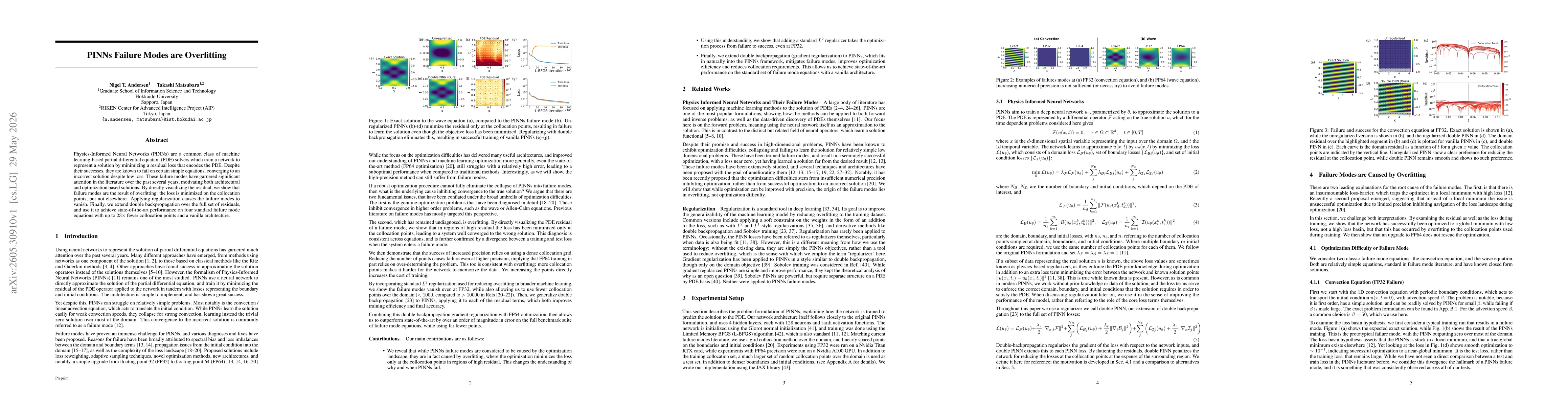
Physics-Informed Neural Networks (PINNs) are a common class of machine learning-based partial differential equation (PDE) solvers which train a network to represent a solution by minimizing a residual loss that encodes the PDE. Despite their successes, they are known to fail on certain simple equations, converging to an incorrect solution despite low loss. These failure modes have garnered significant attention in the literature over the past several years, motivating both architectural and optimization based solutions. By directly visualizing the residual, we show that failure modes are the result of overfitting: the loss is minimized on the collocation points, but not elsewhere. Applying regularization causes the failure modes to vanish. Finally, we extend double backpropagation over the full set of residuals, and use it to achieve state-of-the-art performance on four standard failure mode equations with up to $23\times$ fewer collocation points and a vanilla architecture.
Analysis
AI-generated · verify against the original paper
Generated Jun 1, 2026ResultsWhat the authors found
- Failure modes arise from overfitting to collocation points; reducing collocation density or removing regularization leads to incorrect solutions despite low training loss.
- Incorporating L2 regularization eliminates failure modes even at FP32 and with far fewer collocation points than prior work.
- Generalizing double backpropagation to PINNs (double PINN) improves training efficiency and accuracy by applying extra gradient flow to all residual terms.
- FP64 optimization combined with double backpropagation achieves state-of-the-art performance on four standard failure-mode equations with up to 23x fewer collocation points.
LimitationsWhere the findings need caution
- Regularizers are simple and may not yield the strongest possible convergence speed compared to more advanced techniques.
- Double backpropagation increases per-iteration cost (theoretical doubling) despite fewer points, due to extra gradients.
- The method targets failure modes and may not fully address optimization issues for stiff equations or non-failure-mode problems.
MethodologyHow the work was done
The authors diagnose PINN failures by visualizing PDE residuals to show overfitting: the loss is minimized at collocation points but not in the rest of the domain. They demonstrate that standard L2/L1 regularization reduces failure modes and extend double backpropagation to apply to all residual terms (double PINN), enabling training with fewer collocation points. They compare FP32/FP64 optimization with and without regularization, and show state-of-the-art performance on four standard failure-mode equations using dense residuals and regularization.
SignificanceWhy the work matters
The work reframes PINN failures as an overfitting problem rather than solely optimization landscape issues, offering a simple regularization approach and an enhanced training technique (double backpropagation) that substantially improves accuracy with fewer points, potentially enabling efficient high-precision PINN solvers.
Technical contributionsWhat the work introduces
Introduction of a residual-level visualization to expose overfitting as the cause of PINN failures; demonstration that L2 regularization mitigates failure modes; extension of double backpropagation to PINNs (double PINN) to stabilize training across residuals; empirical state-of-the-art results with substantially fewer collocation points.
NoveltyHow it differs from prior work
First explicit identification of PINN failure modes as overfitting to collocation points; coupling standard regularization with a residual-wide double backpropagation framework to achieve high-precision results with reduced collocation density.
Future workQuestions that remain
- Explore stronger regularization or combined strategies to further accelerate convergence beyond L2/L1.
- Develop more efficient implementations or approximations of double backpropagation to reduce computational overhead further.
- Extend the approach to higher-dimensional PDEs and more complex physics-informed objectives to assess scalability.
Discussion 0