Predicting the next local supernova
Abstract
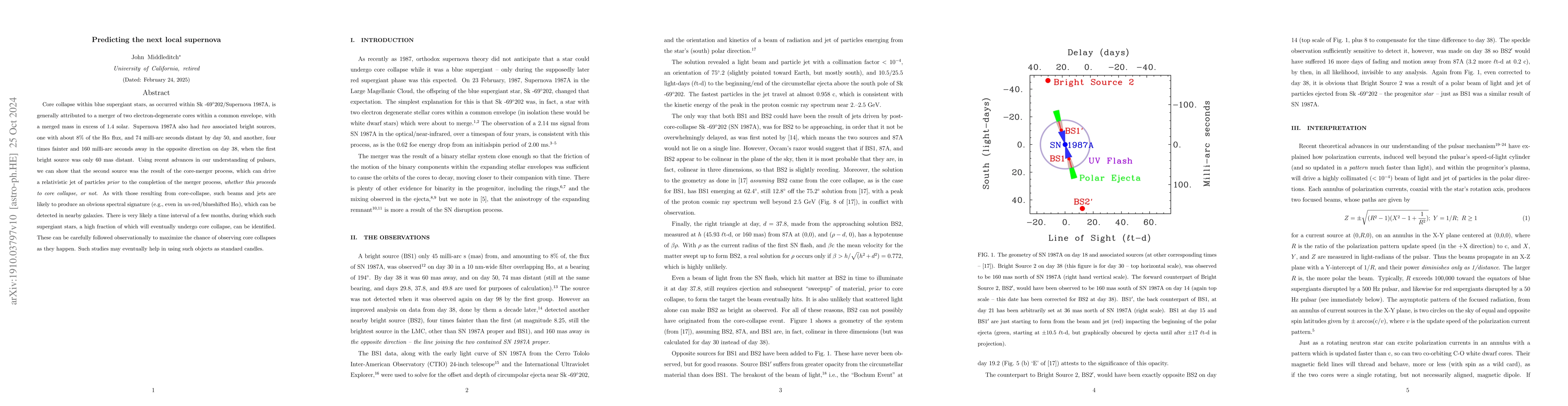
Core collapse within blue supergiant stars, as occurred within Sk -69$^{\circ}$202/Supernova 1987A, is generally attributed to a merger of two electron-degenerate cores within a common envelope, with a merged mass in excess of 1.4 solar. Supernova 1987A also had two associated bright sources, one with about 8% of the H-alpha flux, and 74 milli-arc seconds distant by day 50, and another, four times fainter and 160 milli-arc seconds away in the opposite direction on day 38. Using recent advances in our understanding of pulsars, we can show that the second source was the result of the core-merger process, which can drive a relativistic jet of particles prior to the completion of the merger process, whether this proceeds to core collapse, or not. As with those resulting from core-collapse, such beams and jets are likely to produce an obvious spectral signature (e.g., even in un-red/blue-shifted H-alpha), which can be detected in nearby galaxies. There is very likely a time interval of a few months, during which such supergiant stars, a high fraction of which will eventually undergo core collapse, can be identified. These can be carefully followed observationally to maximize the chance of observing core collapses as they happen. Such studies may eventually help in using such objects as standard candles.
AI Key Findings
Get AI-generated insights about this paper's methodology, results, significance, and more — available when analysis has been generated.
Discussion 0