Preflight: Agentic Last-Mile Verification for AI Software Supply Chains
Abstract
Software dependencies execute within the trust boundary of downstream applications, yet provenance, static analysis, and package-level behavioral approaches do not directly determine how a released artifact behaves for a specific program. We present Preflight, a program-scoped pre-execution verifier for Python dependencies that extracts application-referenced symbols, iteratively synthesizes and validates function-level harnesses, executes resolved artifacts in a restricted environment, records behavioral fingerprints, and compares target behavior against prior versions when suitable baselines exist. We evaluate Preflight on four real software-supply-chain incidents under five application contexts, a 100-package benign corpus, and a controlled function-level versus import-only ablation. Preflight returns malicious verdicts in four incident contexts and a clean verdict in the LiteLLM client context, where the affected proxy-server path is not exercised. All 100 evaluated benign packages receive clean verdicts, with zero observed false positives. In a controlled ablation on Ultralytics and ctx, function-level harnesses expose malicious behavior in both incidents, whereas import-only probing exposes neither. Together, these results show that conditioning behavioral verification on the downstream program can expose security-relevant dependency behavior while remaining selective on benign workloads.
Analysis
AI-generated · verify against the original paper
Generated Jan 1, 0001ResultsWhat the authors found
- Preflight returned malicious verdicts for all four real supply‑chain incidents in the contexts where the vulnerable code path was exercised.
- It returned a clean verdict for the LiteLLM client workload, where the proxy‑server path was not exercised.
- All 100 benign packages in the evaluation corpus received clean verdicts with zero false positives.
- In a controlled ablation on Ultralytics and ctx, function‑level harnesses exposed malicious behavior in both incidents, whereas import‑only probing exposed none.
MethodologyHow the work was done
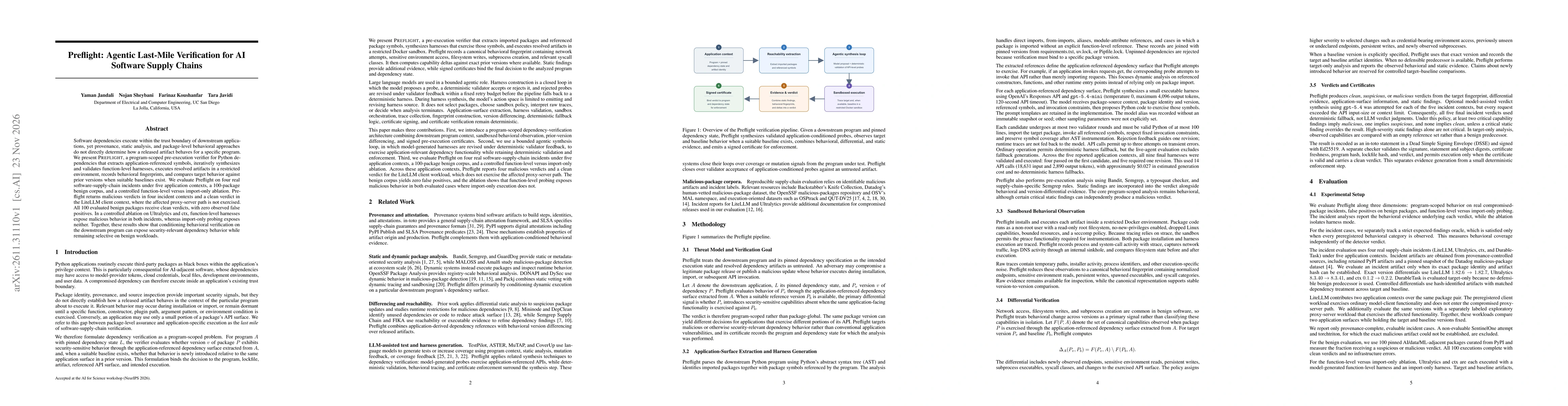
Preflight extracts imported packages and the symbols referenced by the downstream Python program, then iteratively synthesizes function‑level harnesses using a bounded LLM agent, validates them deterministically, and executes the resolved dependency in a restricted Docker sandbox to collect behavioral fingerprints (network, filesystem, syscalls, etc.). It compares these fingerprints against prior versions when baselines exist and signs a pre‑execution certificate binding the decision to the program and dependency state.
SignificanceWhy the work matters
The work demonstrates that conditioning dynamic verification on the downstream program’s referenced API surface can reveal security‑relevant dependency behavior while remaining selective and low‑false‑positive for benign workloads, addressing a gap between package‑level analysis and application‑specific execution.
Technical contributionsWhat the work introduces
A program‑scoped dependency verification architecture that combines downstream program context, LLM‑driven harness synthesis with deterministic validation, sandboxed execution, behavioral fingerprinting, version differencing, and signed certificates to produce actionable security verdicts.
NoveltyHow it differs from prior work
Introducing a last‑mile, agentic verification approach that generates and validates function‑level probes conditioned on the specific application’s API usage, enabling precise detection of malicious behavior that static or import‑only dynamic analyses miss.
Discussion 0