Abstract
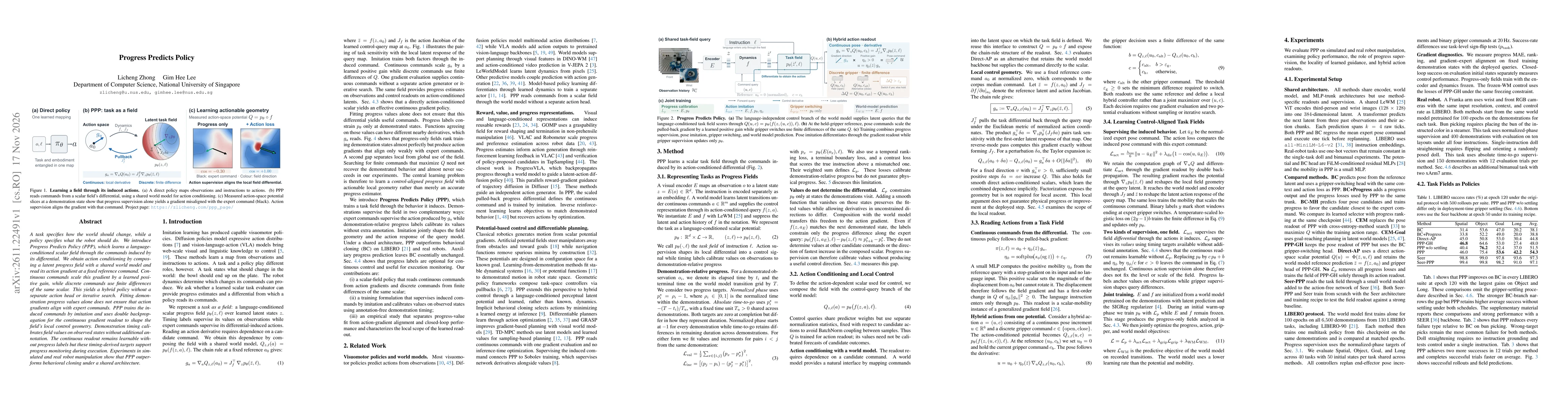
A task specifies how the world should change, while a policy specifies what the robot should do. We introduce Progress Predicts Policy (PPP), which learns a language-conditioned scalar field through the commands induced by its differential. We obtain action conditioning by composing a latent progress field with a shared world model and read its action gradient at a fixed reference command. Continuous commands scale this gradient by a learned positive gain, while discrete commands use finite differences of the same scalar. This yields a hybrid policy without a separate action head or iterative search. Fitting demonstration progress values alone does not ensure that action gradients align with expert commands. PPP trains the induced commands by imitation and uses double backpropagation for the continuous gradient readout to shape the field's local control geometry. Demonstration timing calibrates field values on observed states without additional annotation. The continuous readout remains learnable without progress labels but these timing-derived targets support progress monitoring during execution. Experiments in simulated and real robot manipulation show that PPP outperforms behavioral cloning under a shared architecture.
Analysis
AI-generated · verify against the original paper
Generated Jan 1, 0001ResultsWhat the authors found
- PPP outperforms behavioral cloning (BC) on LIBERO and real‑robot manipulation under a shared architecture.
- Success AUROC of PPP’s calibrated field is 0.84 at rollout end and 0.78 at 5 s, higher than BC+Progress and NoLp baselines.
- PPP’s deployed commands advance on average 1.29 control steps (realized 0.99), exceeding BC’s performance.
- The learned gradient aligns well with expert commands (cosine similarity ≈0.26) and yields steeper local fields than progress‑only baselines.
LimitationsWhere the findings need caution
- Progress‑only fields rank demonstration states well but produce action gradients that weakly align with expert commands.
- Field steepness and alignment depend on joint training with the world model; frozen world‑model variants show reduced performance.
- Failure cases show lower cosine similarity and shallower gradients, indicating sensitivity to field geometry in difficult states.
MethodologyHow the work was done
PPP learns a language‑conditioned scalar progress field pθ(z,ℓ) over latent states, composes it with a shared world model Qz,ℓ(a)=pθ(f(z,a),ℓ), and reads actions from the field’s differential: continuous commands are obtained by scaling the gradient ∇aQ at a fixed reference command with a learned positive gain, and discrete commands by finite differences of the scalar. The field is trained by imitation of expert commands and calibrated on demonstration timing (annotation‑free) using double back‑propagation to shape local control geometry.
SignificanceWhy the work matters
PPP provides a hybrid policy that eliminates the need for a separate action head or iterative search, enabling efficient continuous command generation with a single gradient evaluation while also delivering progress monitoring during execution.
Technical contributionsWhat the work introduces
A scalar‑field policy that reads continuous commands from action gradients and discrete commands from finite differences of the same scalar, trained via imitation loss on induced commands and timing‑derived progress supervision, with double back‑propagation to shape the field’s local control geometry.
NoveltyHow it differs from prior work
Introducing a language‑conditioned progress scalar field that simultaneously serves as a progress estimator and a direct source of robot actions through its differential, eliminating separate action networks and enabling hybrid continuous/discrete command generation.
Discussion 0