Propose with the Gradient, Accept with the Loss: One Hedged Attack for Pixel-Sparse Robustness
Abstract
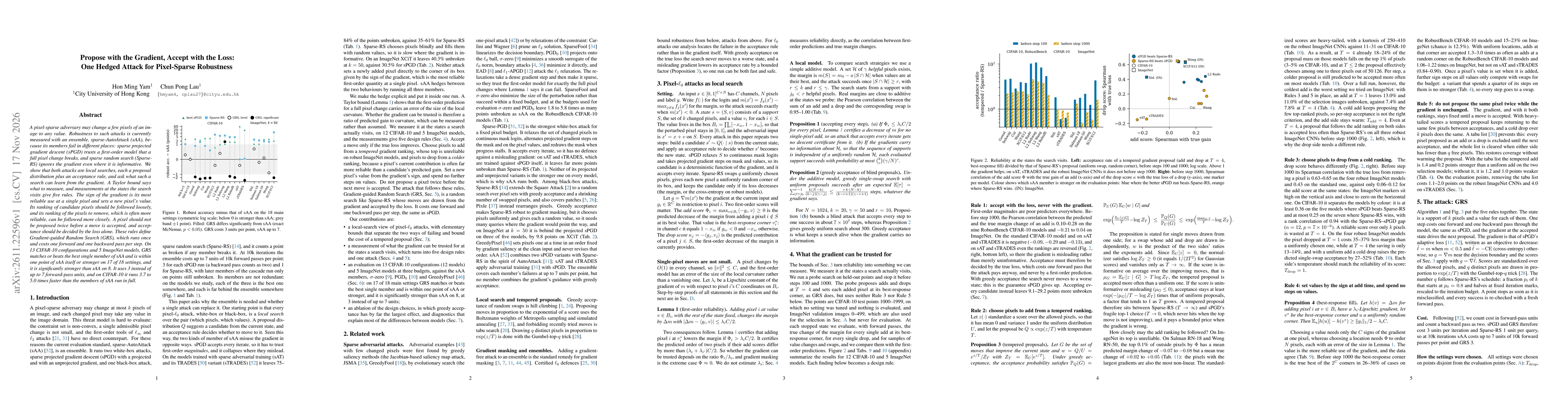
A pixel-sparse adversary may change a few pixels of an image to any value. Robustness to such attacks is currently measured with an ensemble, sparse-AutoAttack (sAA), because its members fail in different places: sparse projected gradient descent (sPGD) trusts a first-order model that a full pixel change breaks, and sparse random search (Sparse-RS) ignores the gradient even where it is informative. We show that both attacks are local searches, each a proposal distribution plus an acceptance rule, and ask what such a search can learn from the gradient. A Taylor bound says what to measure, and measurements at the states the search visits give five rules. The sign of the gradient is its most reliable use at a single pixel and sets a new pixel's value. Its ranking of candidate pixels should be followed loosely, and its ranking of the pixels to remove, which is often more reliable, can be followed more closely. A pixel should not be proposed twice before a move is accepted, and acceptance should be decided by the loss alone. These rules define Gradient-guided Random Search (GRS), which runs once and costs one forward and one backward pass per step. On 13 CIFAR-10 configurations and 5 ImageNet models, GRS matches or beats the best single member of sAA and is within one point of sAA itself or stronger on 17 of 18 settings, and it is significantly stronger than sAA on 8. It uses 3 instead of up to 7 forward-pass units, and on CIFAR-10 it runs 3.7 to 5.0 times faster than the members of sAA run in full.
Analysis
AI-generated · verify against the original paper
Generated Jan 1, 0001ResultsWhat the authors found
- GRS matches or beats the best single member of sparse-AutoAttack (sAA) on 13 CIFAR-10 configurations and 5 ImageNet models.
- GRS is within one robustness‑accuracy point of sAA itself (or stronger) on 17 of 18 settings.
- GRS is significantly stronger than sAA on 8 settings (p<0.05, McNemar test).
- GRS uses only 3 forward‑pass units per point versus up to 7 for sAA.
- On CIFAR-10, GRS runs 3.7 to 5.0 times faster than the full sAA ensemble.
MethodologyHow the work was done
The paper proposes Gradient-guided Random Search (GRS), a single-step local search that uses the sign of the gradient to set new pixel values, ranks candidate pixels loosely, ranks pixels to remove more closely, avoids proposing the same pixel twice before acceptance, and decides acceptance solely based on loss improvement, requiring one forward and one backward pass per step.
SignificanceWhy the work matters
GRS demonstrates that a single, gradient‑guided attack can replace the costly ensemble of attacks used for evaluating pixel‑sparse robustness, providing comparable or better robustness estimates with substantially lower computational overhead.
Technical contributionsWhat the work introduces
The work introduces a local‑search perspective on pixel‑ℓ0 attacks, derives a Taylor‑based bound to measure gradient reliability, formulates five design rules from empirical measurements, and implements these rules in the Gradient‑guided Random Search algorithm.
NoveltyHow it differs from prior work
The novelty lies in explicitly combining gradient‑based proposal distributions with loss‑only acceptance in a random‑search framework, yielding a hedged attack that unifies the strengths of sparse‑PGD and Sparse‑RS while eliminating the need for an ensemble.
Discussion 0