Protein Functional Semantic Alignment via Representation Rectification
Abstract
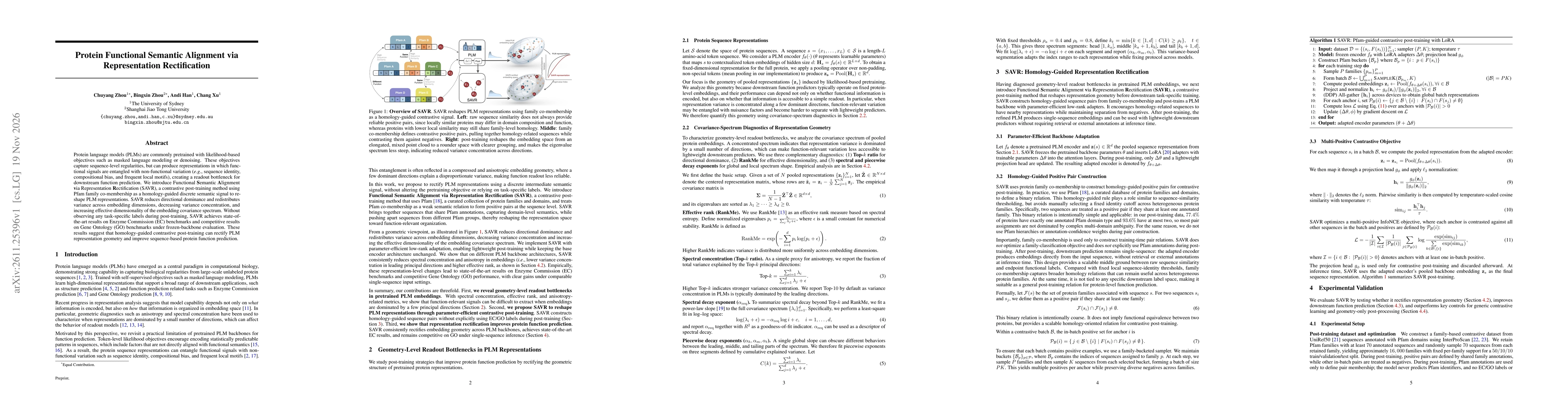
Protein language models (PLMs) are commonly pretrained with likelihood-based objectives such as masked language modeling or denoising. These objectives capture sequence-level regularities, but can produce representations in which functional signals are entangled with non-functional variation (e.g., sequence identity, compositional bias, and frequent local motifs), creating a readout bottleneck for downstream function prediction. We introduce Functional Semantic Alignment via Representation Rectification (SAVR), a contrastive post-training method using Pfam family co-membership as a homology-guided discrete semantic signal to reshape PLM representations. SAVR reduces directional dominance and redistributes variance across embedding dimensions, decreasing variance concentration, and increasing effective dimensionality of the embedding covariance spectrum. Without observing any task-specific labels during post-training, SAVR achieves state-of-the-art results on Enzyme Commission (EC) benchmarks and competitive results on Gene Ontology (GO) benchmarks under frozen-backbone evaluation. These results suggest that homology-guided contrastive post-training can rectify PLM representation geometry and improve sequence-based protein function prediction.
Analysis
AI-generated · verify against the original paper
Generated Jan 1, 0001ResultsWhat the authors found
- Achieves state‑of‑the‑art performance on Enzyme Commission (EC) benchmarks under frozen‑backbone evaluation.
- Attains competitive results on Gene Ontology (GO) benchmarks.
- Reduces variance concentration and directional dominance, increasing effective dimensionality of the embedding covariance spectrum.
- Consistently outperforms the vanilla backbone in low‑identity regimes (30–60% sequence identity) for EC prediction.
MethodologyHow the work was done
SAVR is a contrastive post‑training approach that uses Pfam family co‑membership as a homology‑guided semantic signal to form positive pairs, applies low‑rank LoRA adaptation to the PLM backbone, and learns a two‑layer projection head to reshape the embedding space.
SignificanceWhy the work matters
The work demonstrates that homology‑guided contrastive post‑training can rectify protein language model geometry, enhancing functional signal extraction without requiring task‑specific labels.
Technical contributionsWhat the work introduces
Introduces functional semantic alignment via representation rectification (SAVR), a method that reshapes PLM embeddings using Pfam co‑membership and parameter‑efficient LoRA adaptation to improve downstream function prediction.
NoveltyHow it differs from prior work
First to employ discrete Pfam family co‑membership as a weak semantic signal for contrastive post‑training of PLMs, achieving representation rectification without altering pretraining objectives or using downstream labels.
Discussion 0