PROUD: PaRetO-gUided Diffusion Model for Multi-objective Generation
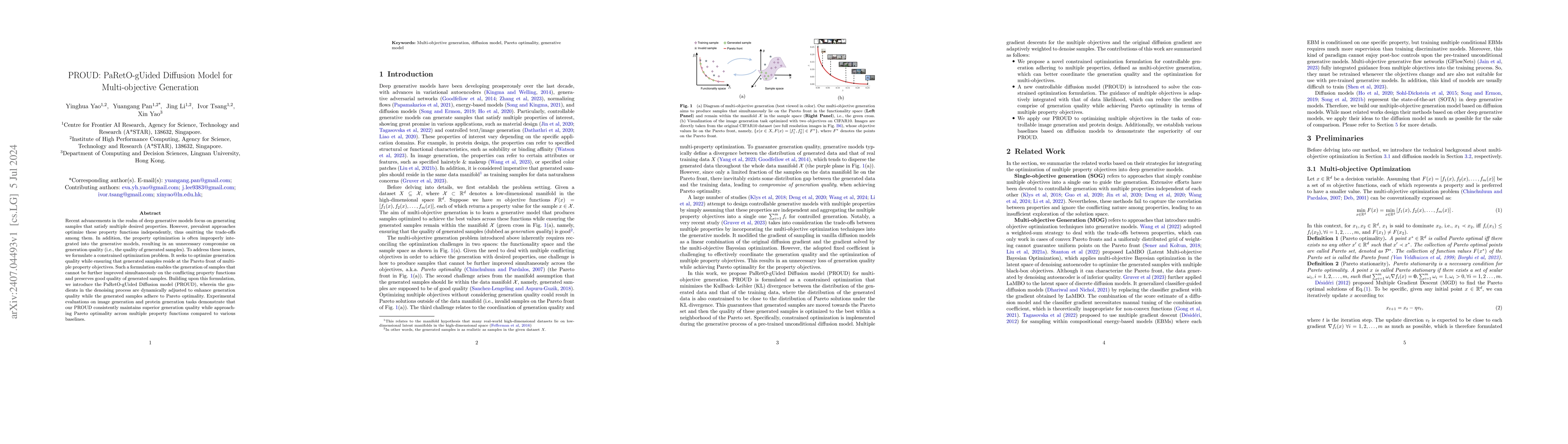
The PROUD model optimizes deep generative models to produce high-quality samples that simultaneously meet multiple desired properties by adhering to Pareto optimality, addressing trade-offs among objectives without compromising generation quality. Experimental results show superior performance in image and protein generation tasks.
Abstract
Recent advancements in the realm of deep generative models focus on generating samples that satisfy multiple desired properties. However, prevalent approaches optimize these property functions independently, thus omitting the trade-offs among them. In addition, the property optimization is often improperly integrated into the generative models, resulting in an unnecessary compromise on generation quality (i.e., the quality of generated samples). To address these issues, we formulate a constrained optimization problem. It seeks to optimize generation quality while ensuring that generated samples reside at the Pareto front of multiple property objectives. Such a formulation enables the generation of samples that cannot be further improved simultaneously on the conflicting property functions and preserves good quality of generated samples. Building upon this formulation, we introduce the PaRetO-gUided Diffusion model (PROUD), wherein the gradients in the denoising process are dynamically adjusted to enhance generation quality while the generated samples adhere to Pareto optimality. Experimental evaluations on image generation and protein generation tasks demonstrate that our PROUD consistently maintains superior generation quality while approaching Pareto optimality across multiple property functions compared to various baselines.
AI Key Findings
Get AI-generated insights about this paper's methodology, results, significance, and more — available when analysis has been generated.
Discussion 0