Psychometrics-Inspired Coreset Selection for Image Quality Assessment
Abstract
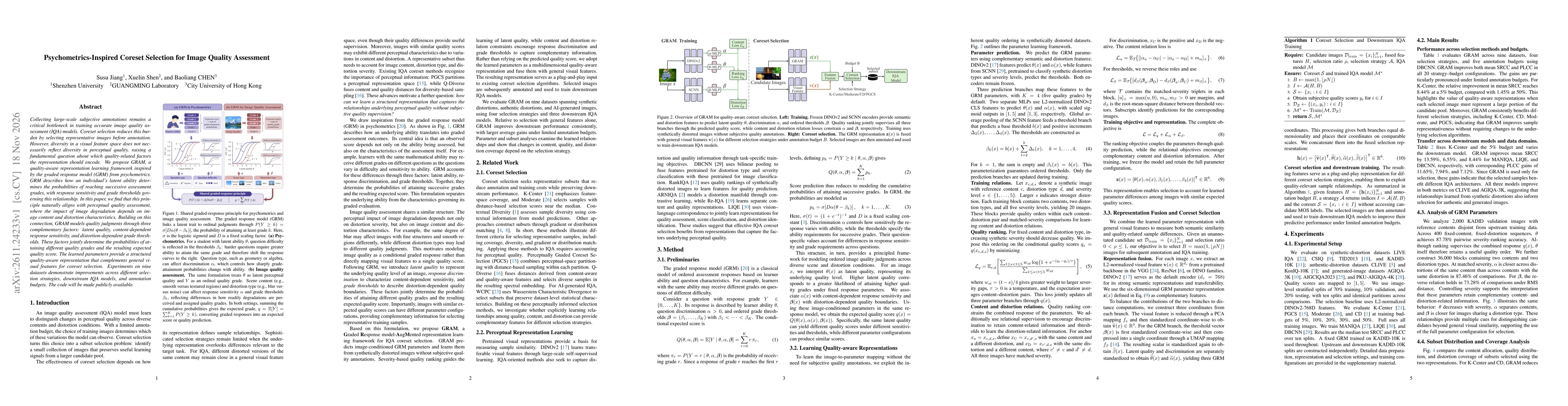
Collecting large-scale subjective annotations remains a critical bottleneck in training accurate image quality assessment (IQA) models. Coreset selection reduces this burden by selecting representative images before annotation. However, diversity in a visual feature space does not necessarily reflect diversity in perceptual quality, raising a fundamental question about which quality-related factors the representation should encode. We propose GRAM, a quality-aware representation learning framework inspired by the graded response model (GRM) from psychometrics. GRM describes how an individual's latent ability determines the probabilities of reaching successive assessment grades, with response sensitivity and grade thresholds governing this relationship. In this paper, we find that this principle naturally aligns with perceptual quality assessment, where the impact of image degradation depends on image content and distortion characteristics. Building on this connection, GRAM models quality judgments through three complementary factors: latent quality, content-dependent response sensitivity, and distortion-dependent grade thresholds. These factors jointly determine the probabilities of attaining different quality grades and the resulting expected quality score. The learned parameters provide a structured quality-aware representation that complements general visual features for coreset selection. Experiments on nine datasets demonstrate improvements across different selection strategies, downstream IQA models, and annotation budgets. The code will be made publicly available.
Analysis
AI-generated · verify against the original paper
Generated Jan 1, 0001ResultsWhat the authors found
- GRAM consistently improves downstream IQA performance across nine datasets compared to using general visual features alone.
- The gains are larger under limited annotation budgets and across multiple selection strategies and downstream IQA models.
- Parameter and subset analyses show that the learned representation captures complementary information about content, quality, and distortion.
LimitationsWhere the findings need caution
- The representation is learned from synthetic distortions without direct subjective quality supervision, which may limit its applicability to unseen real-world degradations.
- The approach relies on the assumption that the GRM formulation adequately captures the complex interactions between content, distortion, and perceived quality.
MethodologyHow the work was done
GRAM learns a quality-aware representation by predicting image-conditioned graded response model (GRM) parameters—latent quality, content-dependent response sensitivity, and distortion-dependent grade thresholds—from synthetically distorted images without subjective annotations, and combines these parameters with general visual features for coreset selection.
SignificanceWhy the work matters
The work demonstrates that psychometrics-inspired, quality-aware representations can effectively guide coreset selection, reducing the need for extensive subjective labeling while enhancing IQA model training.
Technical contributionsWhat the work introduces
A novel framework (GRAM) that models image quality judgments using latent quality, content-sensitive discrimination, and distortion-specific thresholds, providing a multidimensional quality-aware representation for coreset selection.
NoveltyHow it differs from prior work
Introducing a graded response model from psychometrics to image quality assessment, enabling structured, content- and distortion-aware representations that complement generic visual features for data-efficient IQA training.
Future workQuestions that remain
- Explore extensions of the GRM-based representation to incorporate real subjective feedback and other perceptual factors.
- Investigate broader interdisciplinary applications bridging psychometrics and perceptual quality assessment.
Discussion 0