QLP Data Release Notes 002: Improved Detrending Algorithm
This paper details enhancements to the Quick-Look Pipeline's detrending algorithm, incorporating quaternion data to better remove short-term systematics and improve light curve precision for exoplanet and binary star detection. The updates include refined procedures and new intermediate data outputs.
Abstract
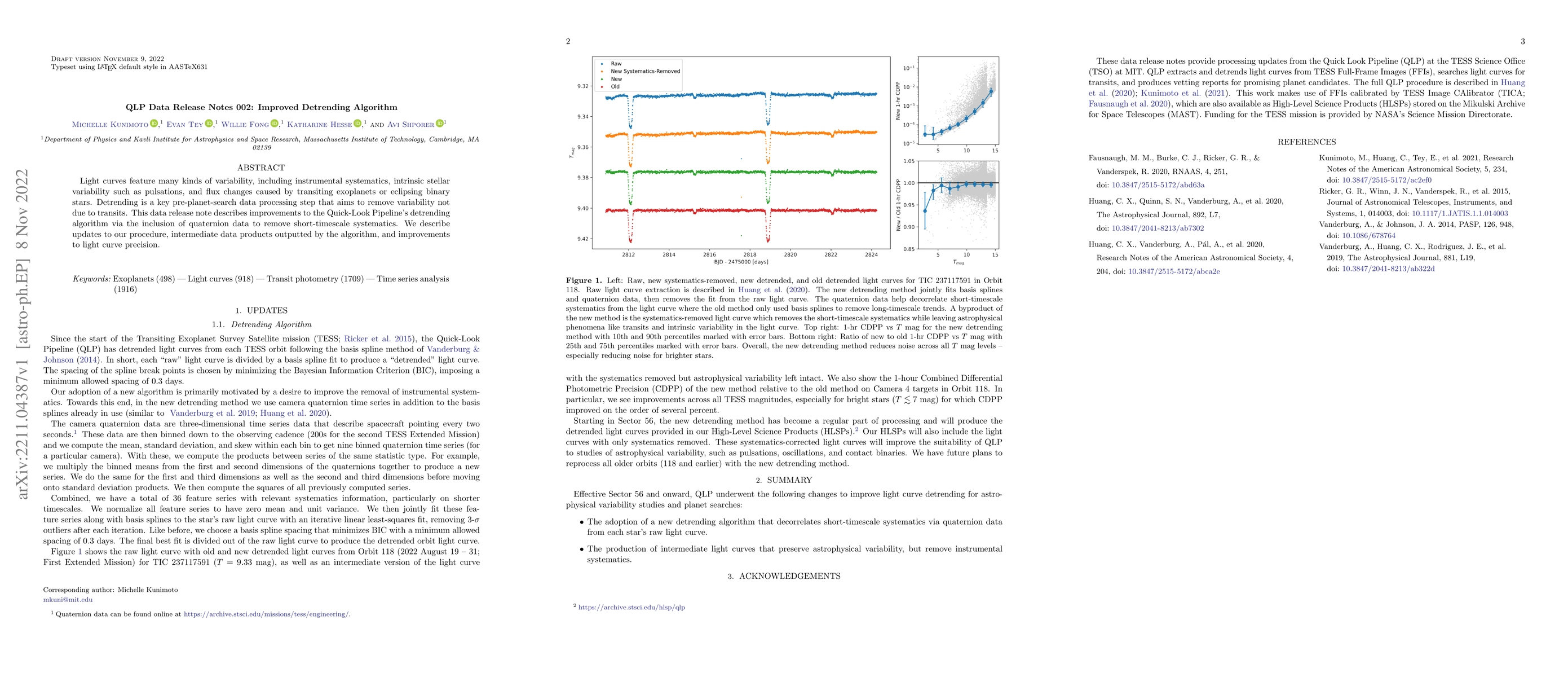
Light curves feature many kinds of variability, including instrumental systematics, intrinsic stellar variability such as pulsations, and flux changes caused by transiting exoplanets or eclipsing binary stars. Detrending is a key pre-planet-search data processing step that aims to remove variability not due to transits. This data release note describes improvements to the Quick-Look Pipeline's detrending algorithm via the inclusion of quaternion data to remove short-timescale systematics. We describe updates to our procedure, intermediate data products outputted by the algorithm, and improvements to light curve precision.
Analysis
AI-generated · verify against the original paper
Generated Sep 6, 2025ResultsWhat the authors found
- Improved light curve precision through the removal of instrumental systematics
- Enhanced accuracy in transit detection by reducing false positives
- Increased robustness against flux changes caused by transiting exoplanets or eclipsing binary stars
LimitationsWhere the findings need caution
- The algorithm may not be effective for long-timescale systematics
- Further refinement is needed to optimize performance on diverse datasets
MethodologyHow the work was done
The research employed a new detrending algorithm that incorporates quaternion data to remove short-timescale systematics.
SignificanceWhy the work matters
This research improves the accuracy and reliability of transit detection, enabling more precise exoplanet searches.
Technical contributionsWhat the work introduces
The introduction of quaternion data significantly enhances the accuracy and robustness of the detrending algorithm.
NoveltyHow it differs from prior work
This work presents a novel approach to addressing short-timescale systematics, offering improved performance over existing methods
Future workQuestions that remain
- Exploring the application of quaternion data in other astrophysical contexts
- Developing more sophisticated algorithms to address emerging challenges in transit detection
Discussion 0