Quantum effects on unconventional pinch point singularities
This paper investigates quantum effects on unconventional pinch point singularities in fracton phases using numerical simulations. Quantum fluctuations significantly alter the shape of pinch points, indicating potential fragility of these phases and revealing characteristic fingerprints of their remnants.
Abstract
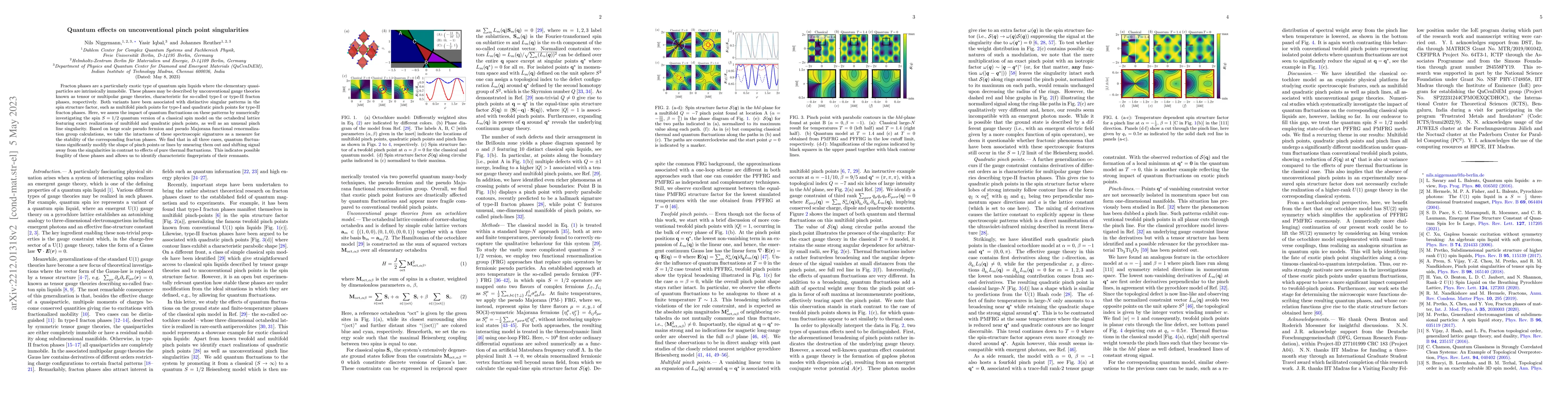
Fracton phases are a particularly exotic type of quantum spin liquids where the elementary quasiparticles are intrinsically immobile. These phases may be described by unconventional gauge theories known as tensor or multipolar gauge theories, characteristic for so-called type-I or type-II fracton phases, respectively. Both variants have been associated with distinctive singular patterns in the spin structure factor, such as multifold pinch points for type-I and quadratic pinch points for type-II fracton phases. Here, we assess the impact of quantum fluctuations on these patterns by numerically investigating the spin $S=1/2$ quantum version of a classical spin model on the octahedral lattice featuring exact realizations of multifold and quadratic pinch points, as well as an unusual pinch line singularity. Based on large scale pseudo fermion and pseudo Majorana functional renormalization group calculations, we take the intactness of these spectroscopic signatures as a measure for the stability of the corresponding fracton phases. We find that in all three cases, quantum fluctuations significantly modify the shape of pinch points or lines by smearing them out and shifting signal away from the singularities in contrast to effects of pure thermal fluctuations. This indicates possible fragility of these phases and allows us to identify characteristic fingerprints of their remnants.
AI Key Findings — Failed
Key findings could not be generated. Please try again later.
Discussion 0