The authors derive fundamental limits on how much squeezing can be achieved in networks of bosonic modes using reservoir-engineered dissipation, showing a lower bound set by basic quantum commutation relations that reaches 1 in the strong-coupling limit. They also show how adding individual driving terms changes the bound (toward 1/2), reformulate the Duan inseparability criterion for three modes in terms of a single parameter, and demonstrate relevance to current electromechanical and nanomechanical experiments, with two-mode bounds potentially reached even at room temperature.
Abstract
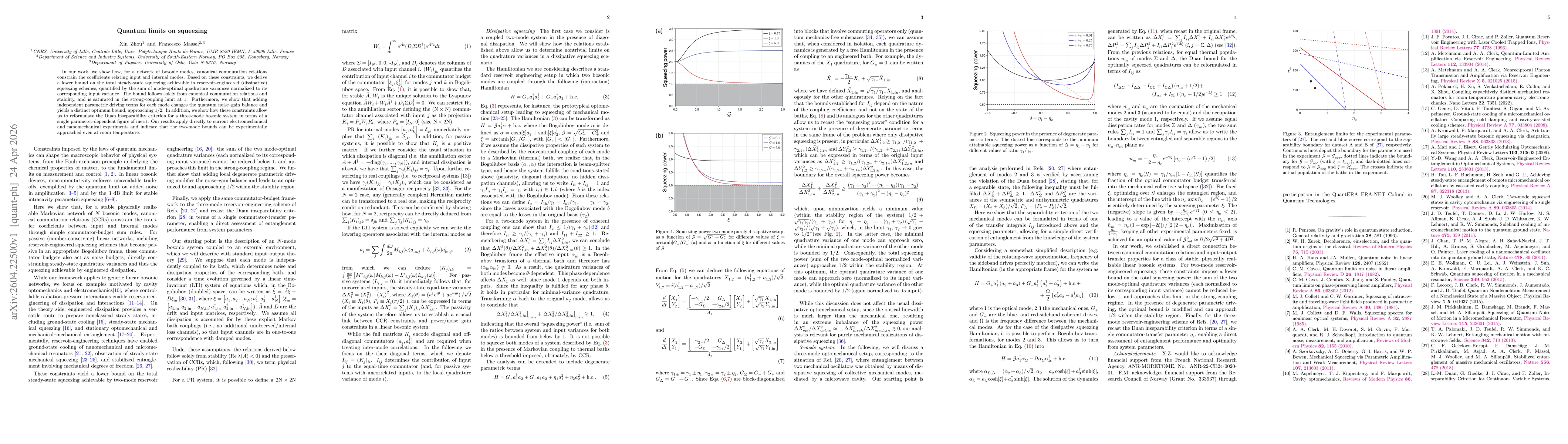
In our work, we show how, for a network of bosonic modes, canonical commutation relations constrain the coefficients relating input and internal modes. Based on these constraints, we derive a lower bound on the total steady-state squeezing achievable in reservoir-engineered (dissipative) squeezing schemes, quantified by the sum of mode-optimal quadrature variances normalized to its corresponding input variance. The bound follows solely from canonical commutation relations and stability, and is saturated in the strong-coupling limit at 1. Furthermore, we show that adding independent parametric driving terms for each mode changes the quantum noise-gain balance and yields a distinct optimum bound, approaching 1/2. In addition, we show how these constraints allow us to reformulate the Duan inseparability criterion for a three-mode bosonic system in terms of a single parameter-dependent figure of merit. Our results apply directly to current electromechanical and nanomechanical experiments and indicate that the two-mode bounds can be experimentally approached even at room temperature.
Analysis
AI-generated · verify against the original paper
Generated Jan 1, 0001ResultsWhat the authors found
- For passive two‑mode reservoir‑engineered squeezing the normalized sum of mode‑optimal quadrature variances is bounded below by 1, with the bound saturated in the strong‑coupling limit.
- Introducing independent parametric driving terms for each mode modifies the noise‑gain balance and yields a distinct optimum bound that can approach 1/2 within the stability region.
- The CCR‑based framework allows the Duan inseparability criterion for a three‑mode bosonic system to be expressed as a single parameter‑dependent figure of merit.
- The derived bounds apply directly to current electromechanical and nanomechanical experiments and indicate that two‑mode limits can be approached even at room temperature.
LimitationsWhere the findings need caution
- The analysis assumes Markovian baths with no hidden loss channels, restricting applicability to systems where all dissipation is captured by explicit input‑output couplings.
- Only passive, number‑conserving linear networks are considered for the primary bound, limiting extension to active or strongly nonlinear configurations.
- Stability is required (Re λ(A)<0), so the bounds do not cover regimes where the system becomes unstable.
MethodologyHow the work was done
The authors employ linear input–output theory for a Markovian network of bosonic modes, deriving commutator‑budget sum rules from canonical commutation relations and stability to constrain the coefficients linking input and internal modes, and use these constraints to obtain lower bounds on steady‑state squeezing and to reformulate the Duan inseparability criterion.
SignificanceWhy the work matters
These results provide universal quantum‑mechanical limits on achievable squeezing in linear bosonic networks, offering a clear benchmark for designing and interpreting reservoir‑engineered squeezing and entanglement experiments across optomechanical platforms.
Technical contributionsWhat the work introduces
Derivation of a universal commutator‑budget constraint from canonical commutation relations that directly yields lower bounds on steady‑state squeezing and enables a compact reformulation of the Duan inseparability criterion for multimode bosonic systems.
NoveltyHow it differs from prior work
First work to link fundamental CCR constraints to explicit, mode‑optimal squeezing limits in dissipative networks and to demonstrate how parametric driving can reduce the bound to 1/2, providing a new perspective on quantum noise‑gain trade‑offs.
Future workQuestions that remain
- Extend the commutator‑budget framework to non‑Markovian environments and to networks with additional internal loss channels.
- Investigate squeezing and entanglement limits for larger multimode systems beyond three modes and for active (gain) elements.
- Experimental validation of the 1/2 bound with parametric driving in room‑temperature electromechanical platforms.
Discussion 0