Abstract
Efficient sequential recommendation has emerged as a promising paradigm for providing real-time personalized service. To deploy models under resource-constrained environment, model compression becomes a necessity, yet existing methods typically apply uniform compression ratios, overlooking the heterogeneity in user intent complexity. This "one-size-fits-all" approach leads to a fundamental Capacity-Complexity Mismatch, where computational resources are either wasted on simple instances or insufficient for complex ones. To address this, we propose RACE (Ranking-uncertainty Aware Capacity-Adaptive Customization for Efficient Sequential Recommendation), a framework that dynamically adapts both model structures and input sequences with uncertainty-aware compression ratios. To ensure capacity-adaptive inference, RACE captures the model's intrinsic uncertainty of its predictions and transforms it into a proactive resource allocator. Specifically, we derive a list-wise ranking-uncertainty metric from the distributional stability of top-$K$ predictions, which serves as a measurable proxy for instance complexity. A lightweight predictor is then trained via self-supervision to anticipate this uncertainty from early-layer features. Guided by this signal, RACE performs instance-specific slimming in two dimensions: a hypernetwork-style channel sensitivity extractor identifies parameter redundancy, while importance-aware progressive sequence filtering mitigates data redundancy. Extensive experiments on four popular datasets demonstrate that RACE outperforms state-of-the-art baselines on accuracy, efficiency, and adaptability.
Analysis
AI-generated · verify against the original paper
Generated Jan 1, 0001ResultsWhat the authors found
- Extensive experiments on four popular datasets show that RACE consistently outperforms state‑of‑the‑art baselines in recommendation accuracy (e.g., higher NDCG@5 and Hit@5).
- RACE achieves significant efficiency gains by reducing inference latency and computational cost through instance‑specific channel and sequence slimming.
- A sensitivity analysis of loss coefficients demonstrates that RACE’s performance is robust across a wide range of hyperparameter settings.
MethodologyHow the work was done
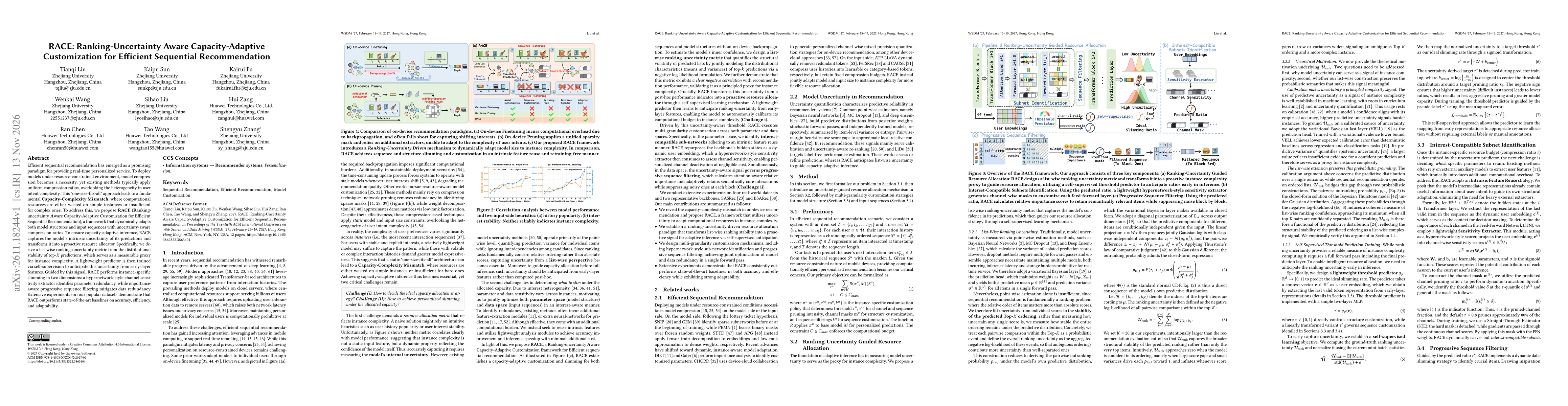
RACE introduces a capacity-adaptive framework that first derives a list-wise ranking‑uncertainty metric from the distributional stability of top‑K predictions to quantify instance complexity. A lightweight self‑supervised predictor uses early‑layer features to anticipate this uncertainty and outputs instance‑specific channel‑pruning and sequence‑pruning ratios. Guided by these ratios, a hypernetwork‑style sensitivity extractor identifies redundant transformer channels, while an importance‑aware progressive sequence filter removes low‑importance items. The resulting subnet and filtered sequence are then used for capacity‑adaptive inference.
SignificanceWhy the work matters
RACE addresses the fundamental Capacity‑Complexity Mismatch in efficient sequential recommendation by dynamically allocating model capacity according to predicted instance difficulty, enabling more effective use of limited resources on edge devices.
Technical contributionsWhat the work introduces
The paper contributes (1) a novel list‑wise ranking‑uncertainty metric as a proxy for instance complexity, (2) a self‑supervised predictor that estimates uncertainty from early‑layer features, (3) a hypernetwork‑style channel sensitivity extractor for parameter‑level slimming, (4) an importance‑aware progressive sequence filtering mechanism, and (5) an integrated capacity‑adaptive inference pipeline that jointly customizes model structure and input sequence.
NoveltyHow it differs from prior work
RACE is the first framework to leverage list‑wise ranking uncertainty to drive instance‑specific model and data compression in sequential recommendation, moving beyond uniform compression and enabling adaptive resource allocation.
Discussion 0