RAGE: Residual-Adaptive Gating for Flow-Based Image Editing
Abstract
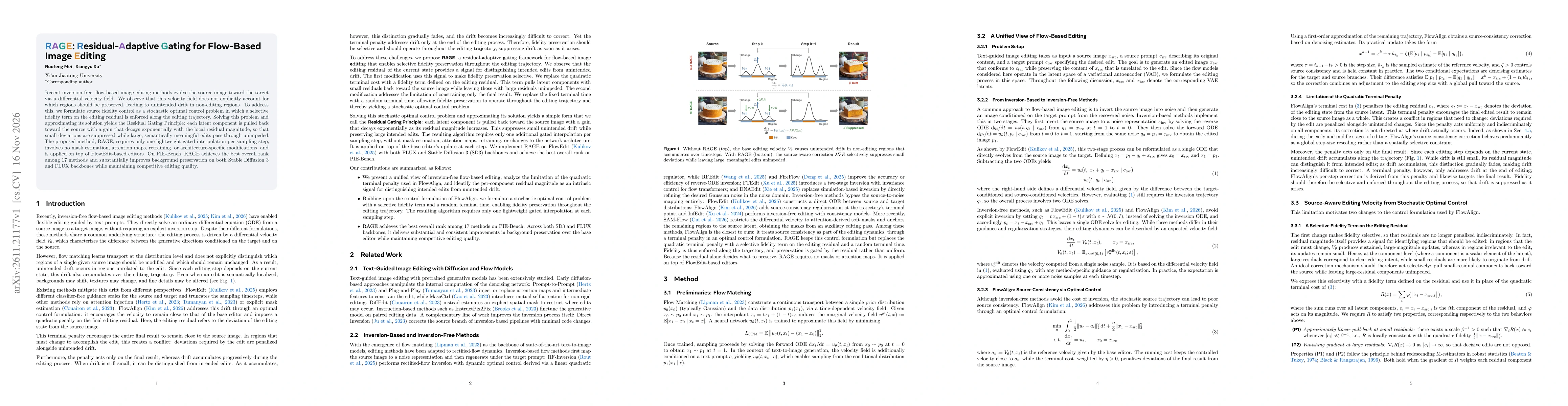
Recent inversion-free, flow-based image editing methods evolve the source image toward the target via a differential velocity field. We observe that this velocity field does not explicitly account for which regions should be preserved, leading to unintended drift in non-editing regions. To address this, we formulate source fidelity control as a stochastic optimal control problem in which a selective fidelity term on the editing residual is enforced along the editing trajectory. Solving this problem and approximating its solution yields the Residual Gating Principle: each latent component is pulled back toward the source with a gain that decays exponentially with the local residual magnitude, so that small deviations are suppressed while large, semantically meaningful edits pass through unimpeded. The proposed method, RAGE, requires only one lightweight gated interpolation per sampling step, involves no mask estimation, attention maps, retraining, or architecture-specific modifications, and is applied on top of FlowEdit-based editors. On PIE-Bench, RAGE achieves the best overall rank among 17 methods and substantially improves background preservation on both Stable Diffusion 3 and FLUX backbones while maintaining competitive editing quality.
Analysis
AI-generated · verify against the original paper
Generated Jan 1, 0001ResultsWhat the authors found
- Achieves the best overall rank among 17 methods on PIE-Bench.
- Significantly improves background preservation on both Stable Diffusion 3 and FLUX backbones while maintaining competitive editing quality.
- Human preference study shows RAGE is consistently preferred over baselines across all comparisons.
LimitationsWhere the findings need caution
- Operates in VAE latent space and thus inherits reconstruction biases of the pretrained backbone.
- Currently limited to rectified‑flow models and may not directly apply to pixel‑space or other generative paradigms.
MethodologyHow the work was done
Formulates source fidelity control as a stochastic optimal control problem with a selective fidelity term on the editing residual and a random terminal time; derives the Residual Gating Principle where each latent component is pulled toward the source with a gain that decays exponentially with its residual magnitude, implemented as a single lightweight gated interpolation per sampling step on top of FlowEdit-based editors.
SignificanceWhy the work matters
Provides a source‑aware, selective fidelity preservation mechanism for inversion‑free flow‑based image editing, addressing unintended drift without requiring masks, attention maps, or retraining, and demonstrates that optimal‑control‑derived dynamics can improve editing reliability across major diffusion backbones.
Technical contributionsWhat the work introduces
Introduces the Residual‑Adaptive Gating (RAGE) framework that adds a single gated interpolation step per sampling iteration, enabling selective fidelity control throughout the editing trajectory without architectural changes.
NoveltyHow it differs from prior work
First to formulate selective source fidelity as a stochastic optimal control problem and to implement an exponential‑decay residual gating that suppresses small unintended drifts while allowing large semantic edits to pass unimpeded.
Future workQuestions that remain
- Extending the residual‑gating mechanism to video editing and pixel‑space models.
- Applying the source‑aware optimal‑control framework to 3D editing and other conditional generation tasks.
Discussion 0