RAVEL: Asynchronous Rolling Inference for Flow-Based Vision-Language-Action Models
Abstract
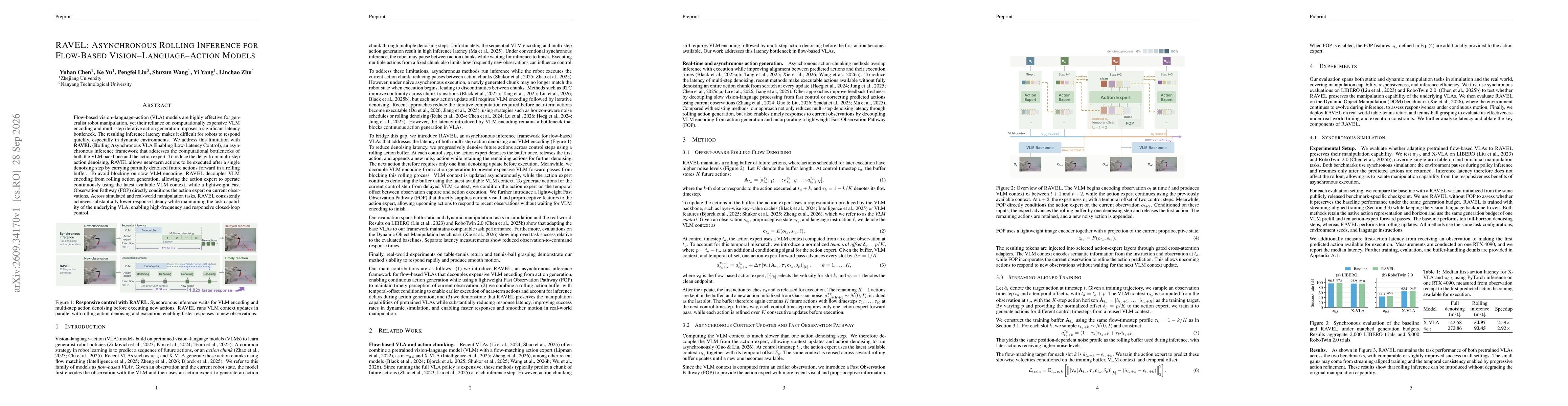
Flow-based vision-language-action (VLA) models are highly effective for generalist robot manipulation, yet their reliance on computationally expensive VLM encoding and multi-step iterative action generation imposes a significant latency bottleneck. The resulting inference latency makes it difficult for robots to respond quickly, especially in dynamic environments. We address this limitation with RAVEL (Rolling Asynchronous VLA Enabling Low-Latency Control), an asynchronous inference framework that addresses the computational bottlenecks of both the VLM backbone and the action expert. To reduce the delay from multi-step action denoising, RAVEL allows near-term actions to be executed after a single denoising step by carrying partially denoised future actions forward in a rolling buffer. To avoid blocking on slow VLM encoding, RAVEL decouples VLM encoding from rolling action generation, allowing the action expert to operate continuously using the latest available VLM context, while a lightweight Fast Observation Pathway (FOP) directly conditions the action expert on current observations. Across simulated and real-world manipulation tasks, RAVEL consistently achieves substantially lower response latency while maintaining the task capability of the underlying VLA, enabling high-frequency and responsive closed-loop control.
Analysis
AI-generated · verify against the original paper
Generated Jan 1, 0001ResultsWhat the authors found
- RAVEL achieves up to 1.92× faster response times, reducing observation-to-command latency from 178.52 ms to 92.97 ms.
- The method maintains comparable task performance to the underlying VLA on simulated benchmarks (LIBERO, RoboTwin2.0) while improving success rates on dynamic manipulation tasks.
- Real‑world experiments (table‑tennis return, conveyor‑belt grasping, tennis‑ball grasping) demonstrate rapid, smooth motion and high‑frequency closed‑loop control.
MethodologyHow the work was done
RAVEL introduces an asynchronous inference framework for flow-based vision-language-action models that decouples VLM encoding from action generation, uses a rolling buffer to progressively denoise future actions, and incorporates a lightweight Fast Observation Pathway (FOP) to condition the action expert on current observations while the VLM context updates in parallel.
SignificanceWhy the work matters
By drastically lowering inference latency without sacrificing manipulation capability, RAVEL enables robots to react promptly in dynamic environments, supporting high‑frequency, responsive closed‑loop control for a broad range of real‑world tasks.
Technical contributionsWhat the work introduces
The paper contributes a rolling action denoising mechanism combined with asynchronous VLM updates and a Fast Observation Pathway, together forming a low‑latency control loop for flow‑based VLA models.
NoveltyHow it differs from prior work
RAVEL is the first to integrate rolling‑buffer denoising with decoupled VLM encoding and streaming‑aligned training for flow‑based vision‑language‑action models, providing asynchronous, low‑latency inference not present in prior VLA approaches.
Discussion 0