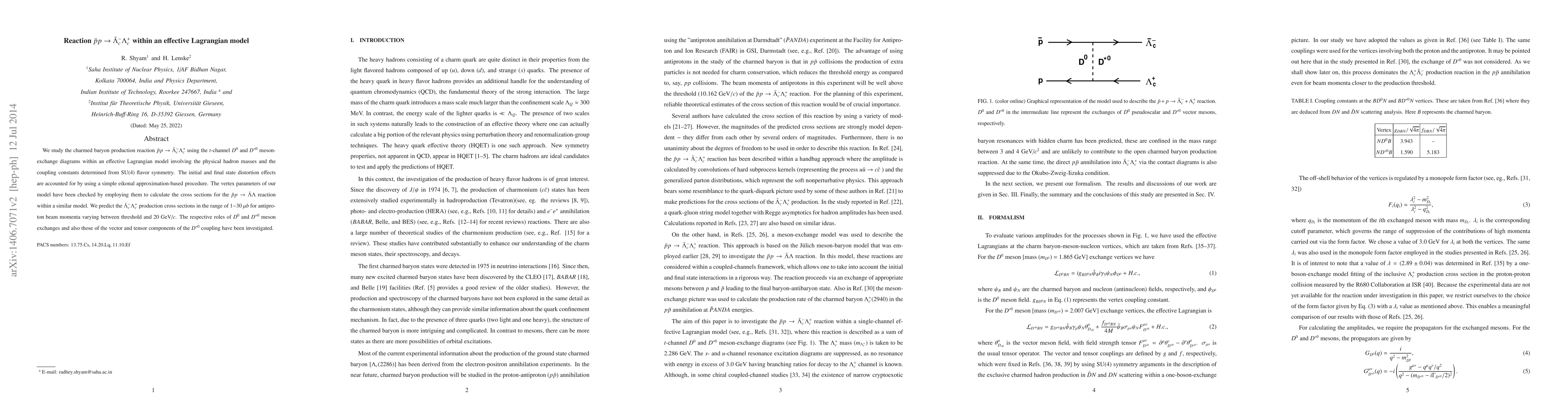
This paper investigates the ${\bar p} p \to {\bar \Lambda}_c^- \Lambda_c^+$ reaction using an effective Lagrangian model with $t$-channel $D^0$ and $D^{*0}$ meson exchanges, predicting cross sections in the range of 1-30 $\mu b$ for antiproton beam momenta from threshold to 20 GeV/c. The study also examines the contributions of $D^0$ and $D^{*0}$ mesons and the $D^{*0}$ coupling's vector and tensor components.
Abstract
We study the charmed baryon production reaction ${\bar p} p \to {\bar \Lambda}_c^- \Lambda_c^+$ using the $t$-channel $D^0$ and $D^{*0}$ meson exchange diagrams within an effective Lagrangian model involving the physical hadron masses and the coupling constants determined from SU(4) flavor symmetry. The initial and final state distortion effects are accounted for by using a simple eikonal approximation based procedure. The vertex parameters of our model have been checked by employing them to calculate the cross sections for the ${\bar p} p \to {\bar \Lambda} \Lambda$ reaction within a similar model. We predict the ${\bar \Lambda}_c^- \Lambda_c^+$ production cross sections in the range of 1-30 $\mu b$ for antiproton beam momenta varying between threshold to 20 GeV/c. The respective roles of $D^0$ and $D^{*0}$ meson exchanges and also those of the vector and tensor components of the $D^{*0}$ coupling have been investigated
AI Key Findings
Get AI-generated insights about this paper's methodology, results, significance, and more — available when analysis has been generated.
Discussion 0