RiboPO: Preference Optimization for Structure- and Stability-Aware RNA Design
Abstract
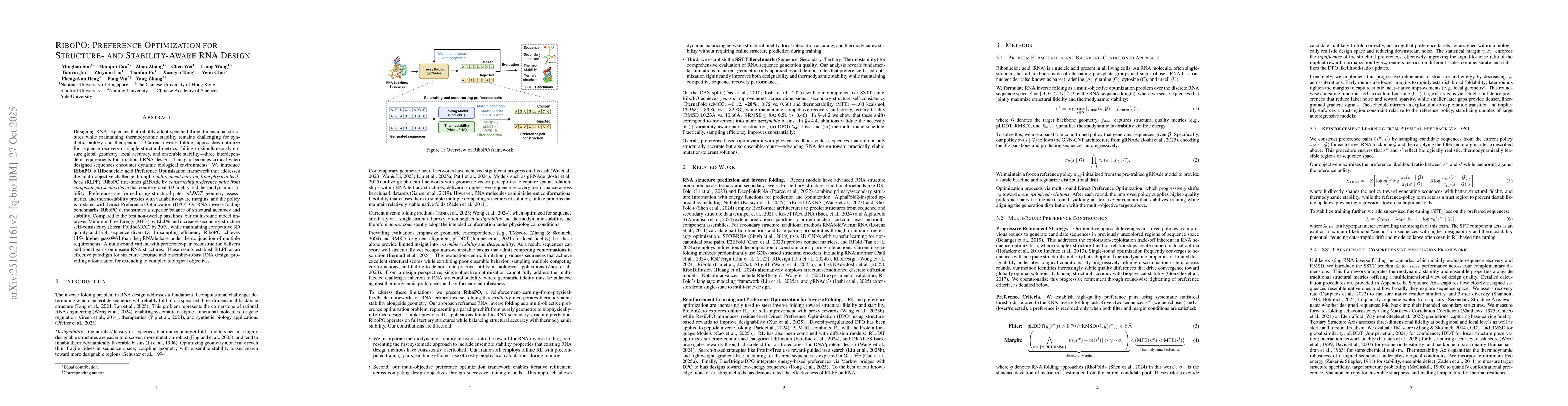
Designing RNA sequences that reliably adopt specified three-dimensional structures while maintaining thermodynamic stability remains challenging for synthetic biology and therapeutics. Current inverse folding approaches optimize for sequence recovery or single structural metrics, failing to simultaneously ensure global geometry, local accuracy, and ensemble stability-three interdependent requirements for functional RNA design. This gap becomes critical when designed sequences encounter dynamic biological environments. We introduce RiboPO, a Ribonucleic acid Preference Optimization framework that addresses this multi-objective challenge through reinforcement learning from physical feedback (RLPF). RiboPO fine-tunes gRNAde by constructing preference pairs from composite physical criteria that couple global 3D fidelity and thermodynamic stability. Preferences are formed using structural gates, PLDDT geometry assessments, and thermostability proxies with variability-aware margins, and the policy is updated with Direct Preference Optimization (DPO). On RNA inverse folding benchmarks, RiboPO demonstrates a superior balance of structural accuracy and stability. Compared to the best non-overlap baselines, our multi-round model improves Minimum Free Energy (MFE) by 12.3% and increases secondary-structure self-consistency (EternaFold scMCC) by 20%, while maintaining competitive 3D quality and high sequence diversity. In sampling efficiency, RiboPO achieves 11% higher pass@64 than the gRNAde base under the conjunction of multiple requirements. A multi-round variant with preference-pair reconstruction delivers additional gains on unseen RNA structures. These results establish RLPF as an effective paradigm for structure-accurate and ensemble-robust RNA design, providing a foundation for extending to complex biological objectives.
Analysis
AI-generated · verify against the original paper
Generated Nov 14, 2025ResultsWhat the authors found
- RiboDiffusion achieves the highest recovery rate at 0.775 with superior tertiary alignment metrics
- R3Design shows exceptional performance in secondary structure consistency with scMCC of 0.663
- RIDiffusion demonstrates strong thermodynamic stability with MFE of -22.40 kcal/mol
LimitationsWhere the findings need caution
- The method's performance may degrade with very long RNA sequences
- Computational costs could be high for large-scale applications
MethodologyHow the work was done
The study employs a comprehensive framework combining sequence design, secondary structure prediction, and tertiary structure refinement using advanced machine learning models and thermodynamic principles.
SignificanceWhy the work matters
This research advances RNA design capabilities by enabling precise control over both structural and thermodynamic properties, with potential applications in drug discovery and synthetic biology.
Technical contributionsWhat the work introduces
Development of a unified framework integrating sequence, secondary, and tertiary structure optimization with ensemble-specific thermodynamic analysis
NoveltyHow it differs from prior work
Introduces a multi-axis evaluation system that simultaneously assesses sequence diversity, structural consistency, thermodynamic stability, and stereochemical quality
Future workQuestions that remain
- Exploring hybrid approaches combining physics-based models with machine learning
- Investigating the design of complex RNA assemblies
Discussion 0