Risk-Controlled Correction for Frozen Multimodal Models under Missing Modalities
Abstract
A deployed multimodal predictor may face missing modalities after its weights can no longer be changed. This raises a question that training-time repair does not answer: what part of the resulting error is still correctable from the information that remains? We show that this part is characterized by the Bayes gap, the difference between the model's prediction and the Bayes prediction given the observed modalities. For cross-entropy and squared error, excess risk measures this gap in the geometry of the loss; ambiguity in the observed modalities cannot be removed. Thus, a badly degraded prediction is not necessarily a correctable one. Estimating the Bayes prediction normally requires labels. However, when a model observing more modalities is conditionally correct, averaging its outputs conditional on the remaining modalities recovers this target without retrieval labels; with the same fixed blend and neighbors, it is no worse in expected cross-entropy or Brier risk than averaging hard labels. Some such assumption is unavoidable: otherwise the target is not identifiable from unlabeled data alone. GUARD (Gated Utility-Aware Recalibration for Deployment) leaves the deployed predictor unchanged. It estimates a candidate correction by retrieval, learns from deployment-matched labeled data when correction is likely to help, and calibrates a threshold on a held-out split by conformal risk control. Under exchangeability, the marginal probability that GUARD applies a correction whose loss increase exceeds a prescribed tolerance is bounded by a preset level, regardless of the learned score. In controlled experiments, correction gain follows headroom rather than raw error; across nine frozen model-dataset pairs spanning six domains, GUARD retains most of blanket correction's gain within harm budgets that blanket correction often exceeds.
Analysis
AI-generated · verify against the original paper
Generated Jan 1, 0001ResultsWhat the authors found
- GUARD retains most of the gain of blanket correction while respecting preset harm budgets across nine frozen model‑dataset pairs spanning six domains.
- Correction gain follows the available headroom rather than raw error, indicating that only the Bayes gap is correctable.
- In controlled experiments, GUARD’s calibrated threshold ensures that the marginal probability of loss increase beyond a tolerance is bounded by the preset level.
LimitationsWhere the findings need caution
- The approach relies on the assumption that a richer‑view predictor is conditionally correct, which is unavoidable for target identifiability.
- Guarantees require exchangeability between training and deployment data and access to labeled deployment‑matched data for learning the correction score.
MethodologyHow the work was done
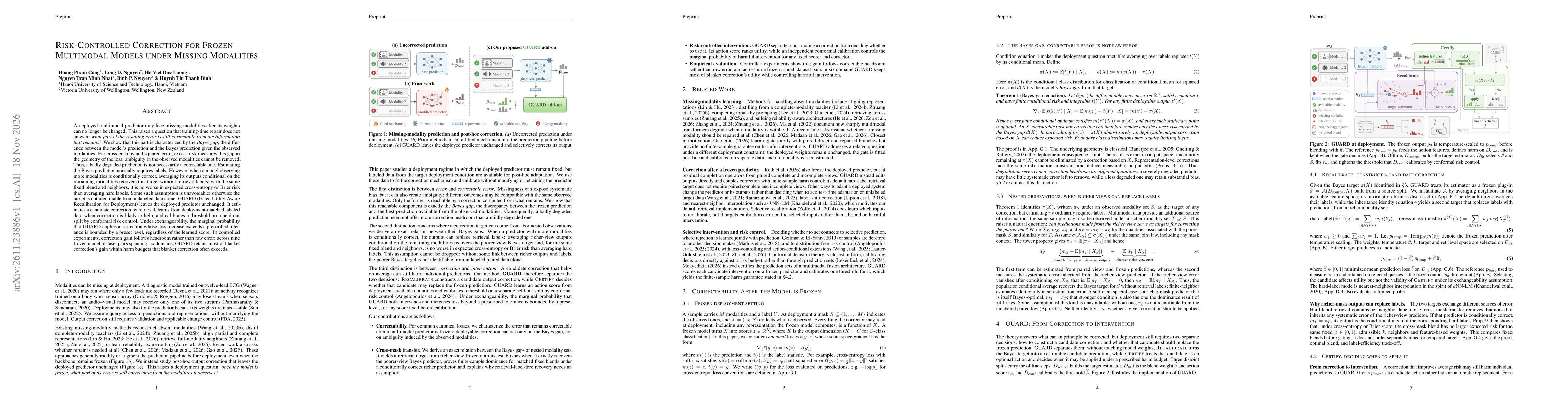
The paper proposes GUARD, a post‑hoc output correction framework for frozen multimodal models that leaves the deployed predictor unchanged, retrieves candidate corrections, learns a score from deployment‑matched labeled data, and calibrates a decision threshold via conformal risk control to guarantee a bounded probability of harmful corrections.
SignificanceWhy the work matters
GUARD provides a practical, risk‑controlled way to improve predictions of frozen multimodal systems at deployment without modifying the original model, addressing a gap left by training‑time repair methods.
Technical contributionsWhat the work introduces
A novel risk‑controlled correction mechanism that combines retrieval‑based candidate generation, learned scoring, and conformal calibration to bound the probability of harmful interventions for frozen multimodal models.
NoveltyHow it differs from prior work
First work to characterize correctable error as the Bayes gap for frozen multimodal predictors and to provide a deployment‑time, label‑free correction method with formal risk guarantees.
Future workQuestions that remain
- Investigate methods to relax the conditional correctness assumption or to identify the Bayes target without labeled data.
- Extend the framework to other loss functions and broader multimodal settings beyond the six domains studied.
Discussion 0