Risk-Controlled Test-Time Adaptation for Vision-Language-Action Models
Abstract
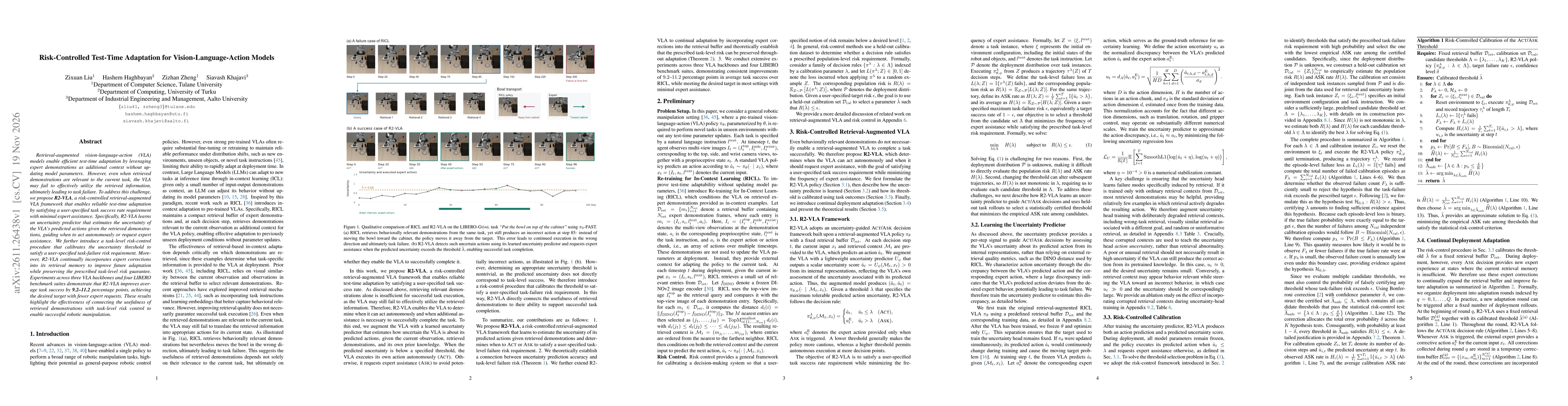
Retrieval-augmented vision-language-action (VLA) models enable efficient test-time adaptation by leveraging expert demonstrations as additional context without updating model parameters. However, even when retrieved demonstrations are relevant to the current task, the VLA may fail to effectively utilize the retrieved information, ultimately leading to task failure. To address this challenge, we propose R2-VLA, a risk-controlled retrieval-augmented VLA framework that enables reliable test-time adaptation by satisfying a user-specified task success rate requirement with minimal expert assistance. Specifically, R2-VLA learns an uncertainty predictor that estimates the uncertainty of the VLA's predicted actions given the retrieved demonstrations, guiding when to act autonomously or request expert assistance. We further introduce a task-level risk-control procedure that calibrates the uncertainty threshold to satisfy a user-specified task-failure risk requirement. Moreover, R2-VLA continually incorporates expert corrections into its retrieval memory to improve future adaptation while preserving the prescribed task-level risk guarantee. Experiments across three VLA backbones and four LIBERO benchmark suites demonstrate that R2-VLA improves average task success by 9.2--11.2 percentage points, achieving the desired target with fewer expert requests. These results highlight the effectiveness of connecting the usefulness of retrieved demonstrations with task-level risk control to enable successful robotic manipulation.
Analysis
AI-generated · verify against the original paper
Generated Jan 1, 0001ResultsWhat the authors found
- R2-VLA improves average task success by 9.2–11.2 percentage points across three VLA backbones and four LIBERO suites.
- The learned uncertainty risk-control strategy achieves the desired success-rate target with fewer expert requests compared to random ASK or other risk-control baselines.
- Incorporating retrieval corruption during uncertainty-head training further increases success rates (e.g., MiniVLA from 59.5% to 62.8%) while reducing ASK rates.
- Increasing the calibration set size to 200 episodes yields a stable success rate (~72%) with a reduced ASK frequency (~49%).
MethodologyHow the work was done
R2-VLA learns an uncertainty predictor that estimates the uncertainty of VLA's predicted actions given retrieved demonstrations, and uses a task-level risk-control procedure to calibrate an uncertainty threshold that satisfies a user-specified task-failure risk requirement. The framework continuously incorporates expert corrections into its retrieval memory and adjusts ACT/ASK decisions based on the calibrated threshold.
SignificanceWhy the work matters
The approach provides a principled way to guarantee task-level success rates at test time without updating model parameters, thereby enabling reliable robotic manipulation with reduced reliance on expert assistance.
Technical contributionsWhat the work introduces
A risk-controlled retrieval-augmented VLA framework that learns uncertainty predictions, calibrates thresholds to meet user-specified failure risk, and continuously updates its retrieval memory with expert corrections.
NoveltyHow it differs from prior work
First method to directly link the usefulness of retrieved demonstrations to task-level risk control, offering provable success-rate guarantees for test-time adaptation of vision-language-action models.
Discussion 0