RoboGolf: Mastering Real-World Minigolf with a Reflective Multi-Modality Vision-Language Model
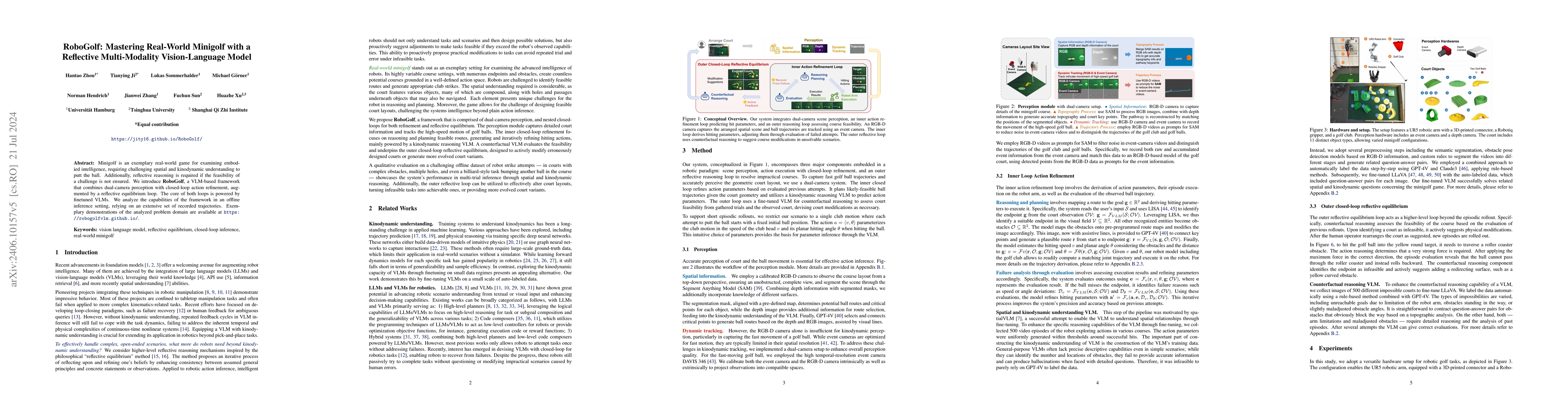
RoboGolf employs a vision-language model to navigate complex minigolf courses using dual-camera inputs and closed-loop control. It successfully tackles even erroneously designed courses, showcasing embodied intelligence through spatial reasoning and corrective abilities.
Abstract
Minigolf, a game with countless court layouts, and complex ball motion, constitutes a compelling real-world testbed for the study of embodied intelligence. As it not only challenges spatial and kinodynamic reasoning but also requires reflective and corrective capacities to address erroneously designed courses. We introduce RoboGolf, a framework that perceives dual-camera visual inputs with nested VLM-empowered closed-loop control and reflective equilibrium loop. Extensive experiments demonstrate the effectiveness of RoboGolf on challenging minigolf courts including those that are impossible to finish.
Analysis
AI-generated · verify against the original paper
Generated Sep 2, 2025ResultsWhat the authors found
- RoboGolf successfully navigates challenging minigolf courses, including those deemed impossible to finish.
- The framework demonstrates improved performance through nested closed-loop design, fine-tuned VLM for kinodynamic reasoning and counterfactual reasoning, and integration of topography information.
- Ablation studies validate the effectiveness of the nested closed-loop design, fine-tuned VLM, and topography information in enhancing task completion.
- Fine-tuned VLM outperforms GPT-4V in generating accurate hitting actions and refinement suggestions for minigolf tasks.
- Counterfactual reasoning VLM provides more precise analysis of failures compared to GPT-4V, identifying subtle differences causing failures.
LimitationsWhere the findings need caution
- The study is limited to a specific minigolf setup and may not generalize well to other complex real-world environments without further adaptations.
- Reliance on specific hardware (UR5 robot arm, DAVIS346 event camera, Azure Kinect RGB-D camera) may limit immediate applicability in diverse settings.
MethodologyHow the work was done
The research introduces RoboGolf, a framework utilizing dual-camera visual inputs with nested VLM-empowered closed-loop control and reflective equilibrium for mastering real-world minigolf. It employs a robot arm, event cameras, and RGB-D cameras for perception and control.
SignificanceWhy the work matters
This research contributes to the development of embodied intelligence by providing a robust framework for real-world complex tasks like minigolf, which require spatial and kinodynamic reasoning, reflective capacities, and corrective actions.
Technical contributionsWhat the work introduces
RoboGolf presents a novel multi-modality vision-language model (VLM) framework integrated with nested closed-loop control and reflective equilibrium for complex real-world tasks.
NoveltyHow it differs from prior work
The framework's unique combination of nested closed-loops, fine-tuned VLM for kinodynamic and counterfactual reasoning, and integration of topography information distinguishes it from existing research in embodied intelligence and robotic control.
Future workQuestions that remain
- Explore the applicability of RoboGolf in other complex real-world environments beyond minigolf.
- Investigate the use of RoboGolf with different robotic hardware to enhance its adaptability and generalizability.
Discussion 0