Robust bounds for American fixed-strike lookback puts
Abstract
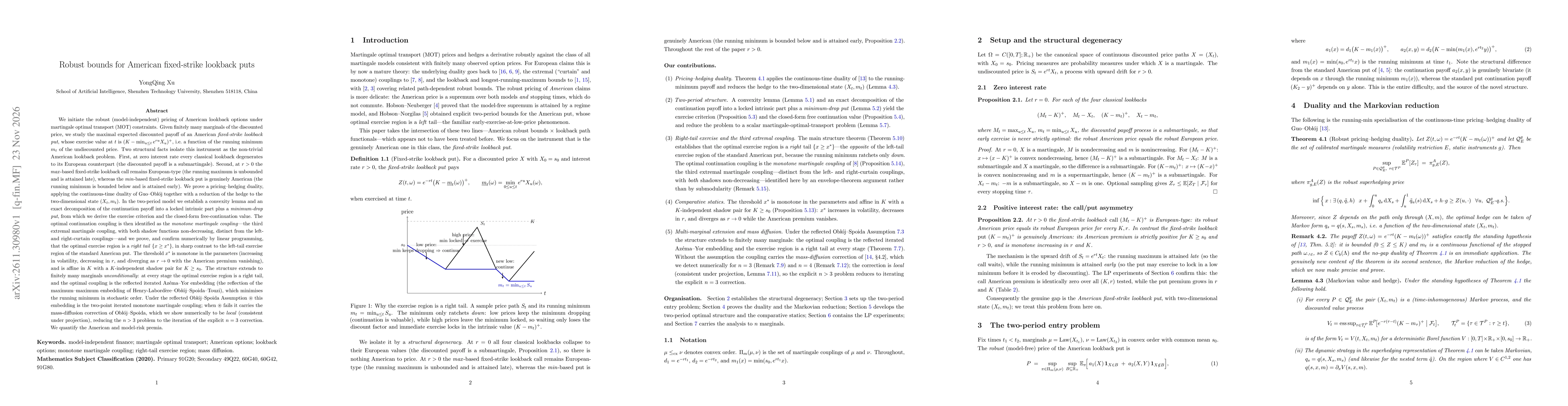
We initiate the robust (model-independent) pricing of American lookback options under martingale optimal transport (MOT) constraints. Given finitely many marginals of the discounted price, we study the maximal expected discounted payoff of an American fixed-strike lookback put, whose exercise value at $t$ is $(K-\min_{u\le t}e^{ru}X_u)^+$, i.e.\ a function of the running minimum $m_t$ of the undiscounted price. Two structural facts isolate this as the non-trivial American lookback problem: at $r=0$ every classical lookback degenerates to its European counterpart, while at $r>0$ the max-based fixed-strike lookback call remains European-type, but the min-based put is genuinely American. We prove a pricing--hedging duality using the continuous-time duality of Guo--Obłoj and reducing the hedge to the two-dimensional state $(X_t,m_t)$. In the two-period model, we establish a convexity lemma and exact decomposition of the continuation payoff, deriving the exercise criterion and closed-form free-continuation value. The optimal continuation coupling is the monotone martingale coupling (the third extremal coupling), and we show that the optimal exercise region is a right tail $\{x\ge x^*\}$, in sharp contrast to the left-tail region of the standard American put. The threshold $x^*$ is monotone in parameters and affine in $K$. For finitely many marginals, the structure extends unconditionally: the optimal exercise region is always a right tail, and the optimal coupling is the reflected iterated Azéma--Yor embedding, minimizing the running minimum in stochastic order. Under the reflected Obłoj--Spoida assumption, this embedding is a two-point iterated monotone coupling; otherwise, it includes a local mass-diffusion correction. We quantify the American and model-risk premia.
Analysis
AI-generated · verify against the original paper
Generated Jan 1, 0001ResultsWhat the authors found
- A pricing–hedging duality holds for the American fixed‑strike lookback put under MOT constraints.
- The optimal continuation coupling is the monotone martingale coupling (the third extremal coupling).
- The optimal exercise region is a right‑tail set {x ≥ x*}, contrasting with the left‑tail region of the standard American put.
- The threshold x* is monotone in model parameters, affine in the strike K, and diverges as the interest rate r → 0.
- For finitely many marginals the optimal coupling is the reflected iterated Azéma–Yor embedding, minimizing the running minimum in stochastic order.
- When the reflected Obłój–Spoida assumption fails, the optimal coupling includes a local mass‑diffusion correction.
- The paper quantifies both the American premium and the model‑risk premium.
LimitationsWhere the findings need caution
- The explicit closed‑form results are derived only for the two‑period model; extensions to more periods rely on iterative constructions.
- The reflected iterated Azéma–Yor embedding assumes the reflected Obłój–Spoida condition; otherwise a mass‑diffusion correction is required, which is only characterized locally.
MethodologyHow the work was done
We apply martingale optimal transport (MOT) constraints with finitely many marginals, prove a pricing–hedging duality using the continuous-time duality of Guo–Obłój, and reduce the hedging problem to the two-dimensional state (X_t, m_t). In the two-period model we establish a convexity lemma and decompose the continuation payoff, deriving an exercise criterion and a closed-form free‑continuation value. For multiple periods we use the reflected iterated Azéma–Yor embedding (or its monotone martingale coupling) to construct the optimal coupling.
SignificanceWhy the work matters
This work provides the first model‑independent robust bounds for an American lookback option, revealing a fundamentally different exercise structure (right‑tail) and coupling strategy compared to classical American puts, and extends the robust pricing framework to path‑dependent American claims with multiple marginals.
Technical contributionsWhat the work introduces
The paper establishes a novel pricing‑hedging duality for American lookback puts, reduces the problem to a two‑dimensional state space, identifies the monotone martingale coupling as optimal, and provides closed‑form expressions for the exercise threshold and continuation value.
NoveltyHow it differs from prior work
It initiates robust, model‑independent pricing of American fixed‑strike lookback puts, discovers a right‑tail optimal exercise region, and links the optimal coupling to the reflected iterated Azéma–Yor embedding, which had not been applied to American lookback options before.
Future workQuestions that remain
- Develop a constructive programme for the explicit n>3 correction terms in the multi‑marginal setting.
- Investigate numerical methods and practical implementations of the mass‑diffusion correction when the Obłój–Spoida assumption fails.
- Explore extensions to other American path‑dependent options and to continuous‑time settings beyond the discrete marginal framework.
Discussion 0