Scherk-Schwarz Compactifications: From Circles to Strings
Abstract
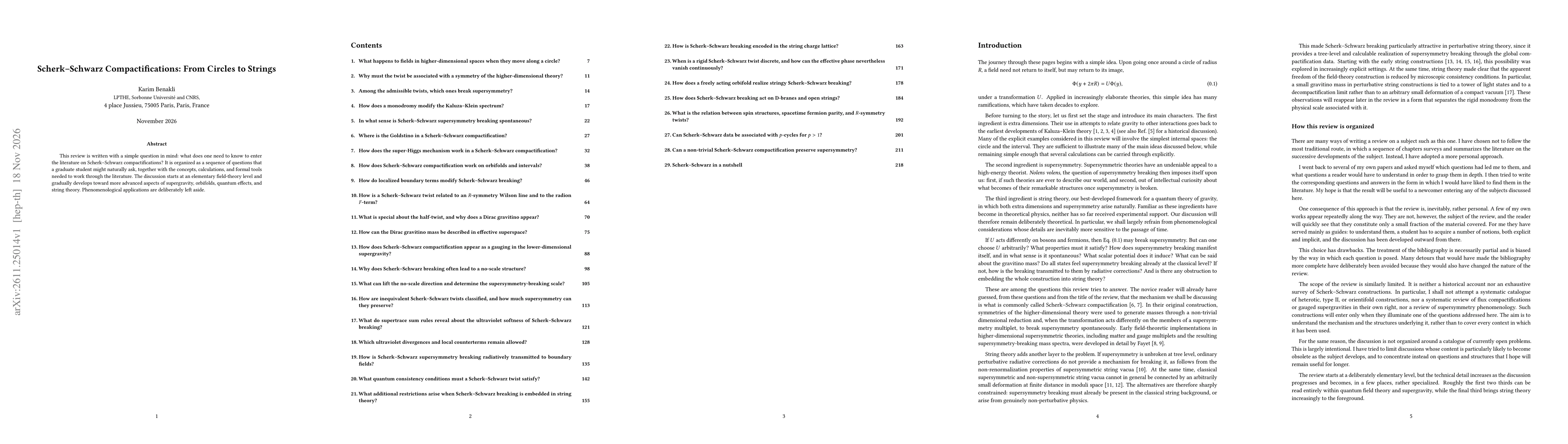
This review is written with a simple question in mind: what does one need to know to enter the literature on Scherk-Schwarz compactifications? It is organized as a sequence of questions that a graduate student might naturally ask, together with the concepts, calculations, and formal tools needed to work through the literature. The discussion starts at an elementary field-theory level and gradually develops toward more advanced aspects of supergravity, orbifolds, quantum effects, and string theory. Phenomenological applications are deliberately left aside.
Analysis
AI-generated · verify against the original paper
Generated Jan 1, 0001ResultsWhat the authors found
- A comprehensive catalogue of 22 questions covering the behavior of fields on circles, supersymmetry-breaking twists, monodromy effects on Kaluza–Klein spectra, the super-Higgs mechanism, orbifold implementations, boundary term modifications, R-symmetry Wilson lines, half-twist gravitino phenomena, effective superspace descriptions, gauged supergravity interpretations, no-scale structures, supersymmetry-breaking scales, classification of inequivalent twists, UV softness and divergence analysis, radiative transmission to boundary fields, quantum consistency conditions, and string-theoretic restrictions.
- An extensive bibliography linking the reviewed topics to original research articles, facilitating further study.
LimitationsWhere the findings need caution
- Phenomenological applications are deliberately omitted, limiting the immediate relevance to model-building contexts.
- The paper is a review and does not present new original research results.
MethodologyHow the work was done
The paper adopts a pedagogical review format, organizing the material as a sequence of questions a graduate student might ask, and systematically presenting the necessary concepts, calculations, and formal tools from elementary field theory up to supergravity, orbifolds, quantum effects, and string theory.
SignificanceWhy the work matters
The review provides a unified, question-driven entry point for newcomers to the Scherk–Schwarz literature, bridging elementary field theory and advanced string-theoretic applications, thereby lowering the barrier to understanding a complex and widely used mechanism for supersymmetry breaking.
Technical contributionsWhat the work introduces
The work synthesizes and organizes existing knowledge on Scherk–Schwarz compactifications into a coherent, pedagogical framework that maps out the logical progression of concepts and tools needed for advanced study.
NoveltyHow it differs from prior work
The novelty lies in the question‑driven pedagogical structure that systematically guides readers from basic field‑theoretic intuition to sophisticated string‑theoretic implementations of Scherk–Schwarz compactifications.
Discussion 0