Self-gravity depletes superradiant clouds
Abstract
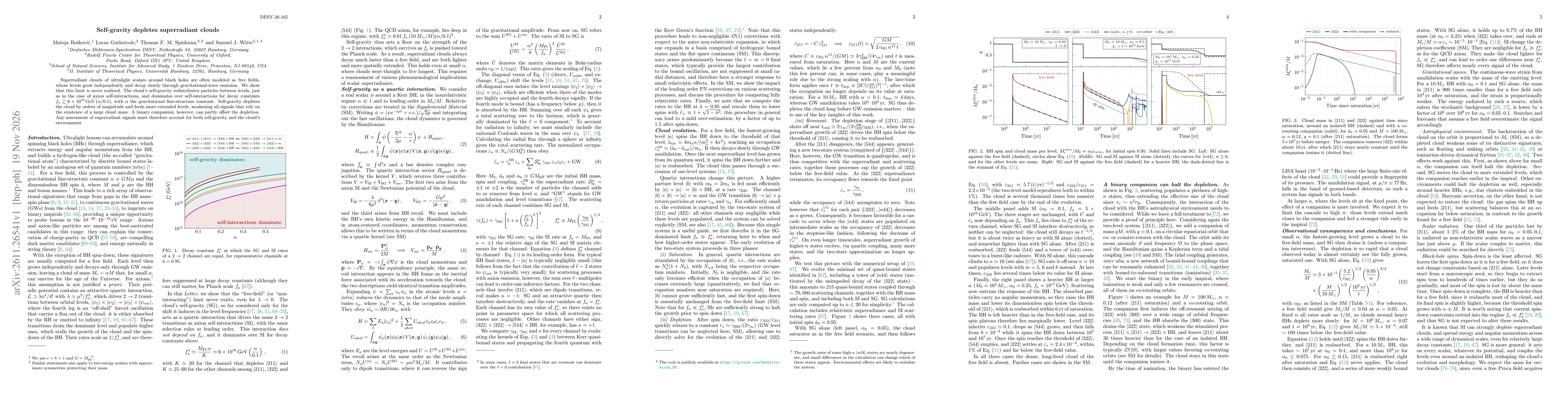
Superradiant clouds of ultralight scalars around black holes are often modeled as free fields, whose levels grow independently and decay slowly through gravitational-wave emission. We show that this limit is never realized. The cloud's self-gravity redistributes particles between levels, just as in the case of axion self-interactions, and dominates over self-interactions for decay constants $f_a\gtrsim6\times10^{16}\,{\rm GeV}\,(α/0.1)$, with $α$ the gravitational fine-structure constant. Self-gravity depletes the cloud by orders of magnitude and feeds more extended levels, weakening all signals that rely on the existence of a large cloud mass. A binary companion, however, can partly offset the depletion. Any assessment of superradiant signals must therefore account for both self-gravity and the cloud's environment.
Analysis
AI-generated · verify against the original paper
Generated Jan 1, 0001ResultsWhat the authors found
- Self‑gravity acts as a quartic interaction that redistributes particles between cloud levels, dominating over axion self‑interactions for decay constants f_a ≳ 6×10^16 GeV (α/0.1).
- The cloud mass is depleted by orders of magnitude and the cloud becomes more spatially extended, weakening superradiant signals.
- A binary companion can partially offset the depletion by resonantly driving cloud formation.
LimitationsWhere the findings need caution
- The analysis is restricted to the non‑relativistic regime (α≪1) and leading order in the cloud mass ratio M_c/M.
- Relativistic corrections are treated only in supplemental material and not fully incorporated in the main results.
MethodologyHow the work was done
The authors model the dynamics of a scalar field around a Kerr black hole in the non-relativistic regime (α≪1) using a Hamiltonian formalism that includes a quartic self‑gravity interaction term derived from the Newtonian potential of the cloud, and they solve the resulting coupled mode equations for occupation numbers, incorporating both self‑gravity and axion self‑interaction kernels, as well as recoil effects and binary companion perturbations.
SignificanceWhy the work matters
The work demonstrates that the commonly used free‑field approximation for superradiant clouds is never realized, implying that all phenomenological predictions for ultralight boson signals must account for self‑gravity and environmental effects.
Technical contributionsWhat the work introduces
Derivation of a self‑gravity quartic interaction kernel for the cloud and its incorporation into a Hamiltonian framework that yields coupled evolution equations for mode occupations, enabling quantitative comparison with axion self‑interactions.
NoveltyHow it differs from prior work
Identification of self‑gravity as the dominant mechanism for level mixing and cloud depletion in superradiant systems, establishing a floor for interaction strength that persists even when axion self‑couplings vanish.
Future workQuestions that remain
- A wider exploration of higher‑ℓ modes and additional transition channels beyond the two‑state model.
- Detailed study of ionization effects and cloud evolution in binary systems over longer timescales.
Discussion 0