This paper proposes a method for simulating quantum many-body systems using a single circuit QED device, leveraging a transmon qubit and a long-lived cavity mode. It demonstrates that sequential quantum operations can efficiently prepare matrix product state representations of spin chains, significantly reducing decoherence compared to digital methods.
Abstract
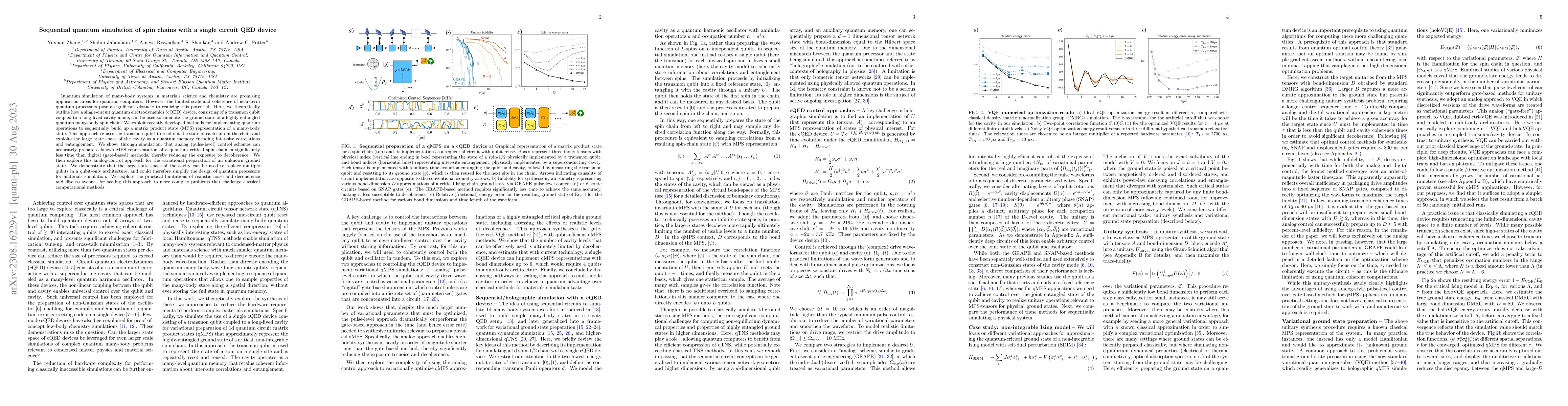
Quantum simulation of many-body systems in materials science and chemistry are promising application areas for quantum computers. However, the limited scale and coherence of near-term quantum processors pose a significant obstacle to realizing this potential. Here, we theoretically outline how a single-circuit quantum electrodynamics (cQED) device, consisting of a transmon qubit coupled to a long-lived cavity mode, can be used to simulate the ground state of a highly-entangled quantum many-body spin chain. We exploit recently developed methods for implementing quantum operations to sequentially build up a matrix product state (MPS) representation of a many-body state. This approach re-uses the transmon qubit to read out the state of each spin in the chain and exploits the large state space of the cavity as a quantum memory encoding inter-site correlations and entanglement. We show, through simulation, that analog (pulse-level) control schemes can accurately prepare a known MPS representation of a quantum critical spin chain in significantly less time than digital (gate-based) methods, thereby reducing the exposure to decoherence. We then explore this analog-control approach for the variational preparation of an unknown ground state. We demonstrate that the large state space of the cavity can be used to replace multiple qubits in a qubit-only architecture, and could therefore simplify the design of quantum processors for materials simulation. We explore the practical limitations of realistic noise and decoherence and discuss avenues for scaling this approach to more complex problems that challenge classical computational methods.
AI Key Findings
Get AI-generated insights about this paper's methodology, results, significance, and more — available when analysis has been generated.
Discussion 0