Sharp High-Dimensional Self-Normalized Central Limit Theorems
Abstract
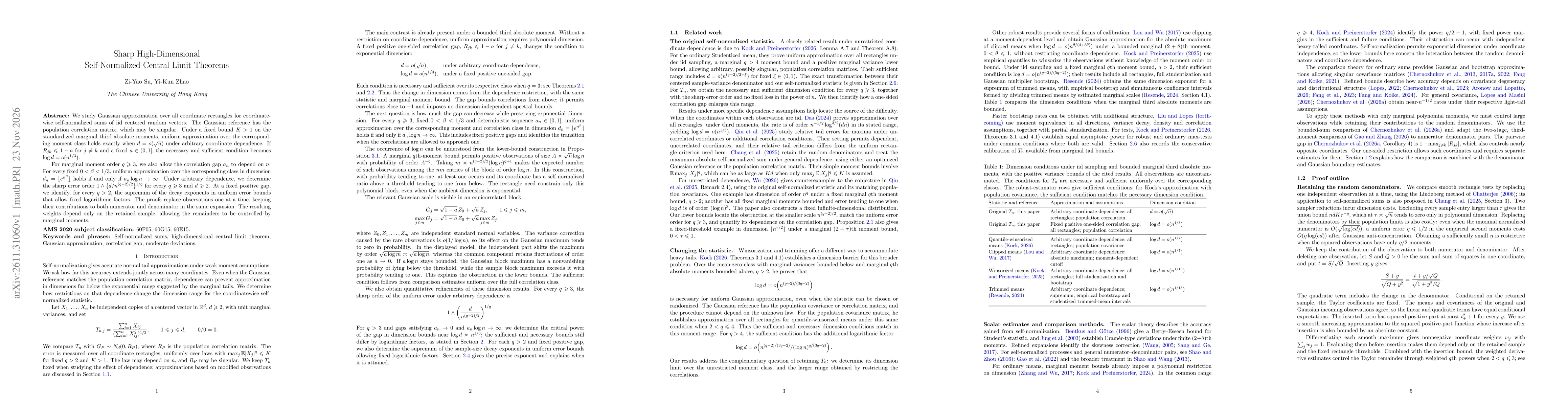
We study Gaussian approximation over all coordinate rectangles for coordinatewise self-normalized sums of iid centered random vectors. The Gaussian reference has the population correlation matrix, which may be singular. Under a fixed bound $K>1$ on the standardized marginal third absolute moments, uniform approximation over the corresponding moment class holds exactly when $d=o(\sqrt n)$ under arbitrary coordinate dependence. If $R_{jk}\le1-a$ for $j\ne k$ and a fixed $a\in(0,1]$, the necessary and sufficient condition becomes $\log d=o(n^{1/3})$. For marginal moment order $q\ge3$, we also allow the correlation gap $a_n$ to depend on $n$. For every fixed $0<β<1/3$, uniform approximation over the corresponding class in dimension $d_n=\lfloor e^{n^β}\rfloor$ holds if and only if $a_n\log n\to\infty$. Under arbitrary dependence, we determine the sharp error order $1\wedge\{d/n^{(q-2)/2}\}^{1/q}$ for every $q\ge3$ and $d\ge2$. At a fixed positive gap, we identify, for every $q>2$, the supremum of the decay exponents in uniform error bounds that allow fixed logarithmic factors. The proofs replace observations one at a time, keeping their contributions to both numerator and denominator in the same expansion. The resulting weights depend only on the retained sample, allowing the remainders to be controlled by marginal moments.
Analysis
AI-generated · verify against the original paper
Generated Jan 1, 0001ResultsWhat the authors found
- Uniform approximation over coordinate rectangles holds exactly when d = o(√n) under arbitrary coordinate dependence given a fixed bound K>1 on standardized marginal third absolute moments.
- If the correlation matrix satisfies R_{jk} ≤ 1−a for j≠k with a fixed a∈(0,1], the necessary and sufficient condition becomes log d = o(n^{1/3}).
- For marginal moment order q≥3 and any 0<β<1/3, uniform approximation in dimension d_n = ⌊e^{n^β}⌋ holds if and only if a_n log n → ∞, allowing the correlation gap a_n to depend on n.
- Under arbitrary dependence the sharp error order is 1 ∧ {d / n^{(q−2)/2}}^{1/q} for every q≥3 and d≥2.
- At a fixed positive correlation gap, the supremum of decay exponents in uniform error bounds that permit fixed logarithmic factors is identified for every q>2.
LimitationsWhere the findings need caution
- The analysis assumes a fixed bound K>1 on standardized marginal third absolute moments (or higher moments for q≥3).
- Results rely on either arbitrary dependence with polynomial dimension growth or a fixed positive correlation gap; cases with vanishing gaps or heavier tails are not covered.
- The framework is limited to i.i.d. observations; extensions to dependent time series are not addressed.
MethodologyHow the work was done
The authors analyze Gaussian approximation for coordinatewise self‑normalized sums of i.i.d. centered random vectors by replacing observations one at a time, keeping contributions to both numerator and denominator in the same expansion; the resulting weights depend only on the retained sample, allowing remainders to be controlled via marginal moments.
SignificanceWhy the work matters
These results provide precise, sharp dimension thresholds and error rates for high‑dimensional self‑normalized central limit theorems, clarifying how dependence and moment conditions affect Gaussian approximation and extending the theoretical foundation for simultaneous inference in high dimensions.
Technical contributionsWhat the work introduces
Introduces a novel proof technique that replaces observations one by one while preserving contributions to both numerator and denominator, yielding sample‑dependent weights that enable tight control of remainder terms via marginal moments.
NoveltyHow it differs from prior work
Establishes necessary and sufficient high‑dimensional conditions and exact error orders for self‑normalized sums under arbitrary dependence, and determines the optimal decay exponents for uniform error bounds with fixed logarithmic factors.
Discussion 0