SIRAZ: Sparse Inter-Layer Residual Aggregation for Zero-Shot Visual Neural Decoding
Abstract
Brain-computer interfaces aim to establish direct communication between neural activity and external systems, making interpretation of brain signals an important problem. In this context, neural visual decoding seeks to infer visual information from neural activity by learning a mapping between brain responses and the corresponding visual stimuli. It investigates how visual information emerges from neural signals and relates to perceptual processing while enabling the reconstruction or retrieval of visual stimuli from neural signals. Our brain primarily follows a hierarchical pathway to process visual information captured by the eye. However, neural representations learned by existing methods differ fundamentally from those produced by the biological visual system. To bridge this gap and mimic the human vision hierarchy, we introduce Sparse Inter-layer Residual Aggregation for Zero-shot (SIRAZ). SIRAZ is a framework that aligns neural visual representations by jointly modeling early visual processes via fovea- and magnocellular-pathway-inspired Difference-of-Gaussians transformations. To align the semantic information with neural information, it extracts multiple intermediate representations of the image at multiple depths and passes them through the Residual Gated Adapter Mechanism. To study the temporal dynamics of neural signals, the Direction-aware Multi-Scale Temporal Attention Encoder is introduced to align the learned neural representation with the final visual representation. The proposed framework achieves 92.5% top-1 and 99.27% top-5 accuracy in the intra-subject setting on the THINGS-EEG dataset, and 50.25% and 75% top-1 and top-5 accuracy in the THINGS-MEG dataset. The results indicate that combining biologically motivated visual representations with the structured modalities of neural dynamics improves cross-modal alignment and zero-shot image retrieval.
Analysis
AI-generated · verify against the original paper
Generated Jan 1, 0001ResultsWhat the authors found
- Achieves 92.5% top-1 and 99.27% top-5 accuracy in intra-subject EEG (THINGS-EEG) zero-shot image retrieval.
- Achieves 50.25% top-1 and 75% top-5 accuracy in MEG (THINGS-MEG) zero-shot image retrieval.
- Demonstrates state-of-the-art performance compared to prior neural‑visual decoding methods.
LimitationsWhere the findings need caution
- Performance drops markedly from intra‑subject to inter‑subject settings, indicating subject‑specific neural variability.
- The approach relies on pretrained vision backbones that may limit adaptability to entirely new visual domains.
MethodologyHow the work was done
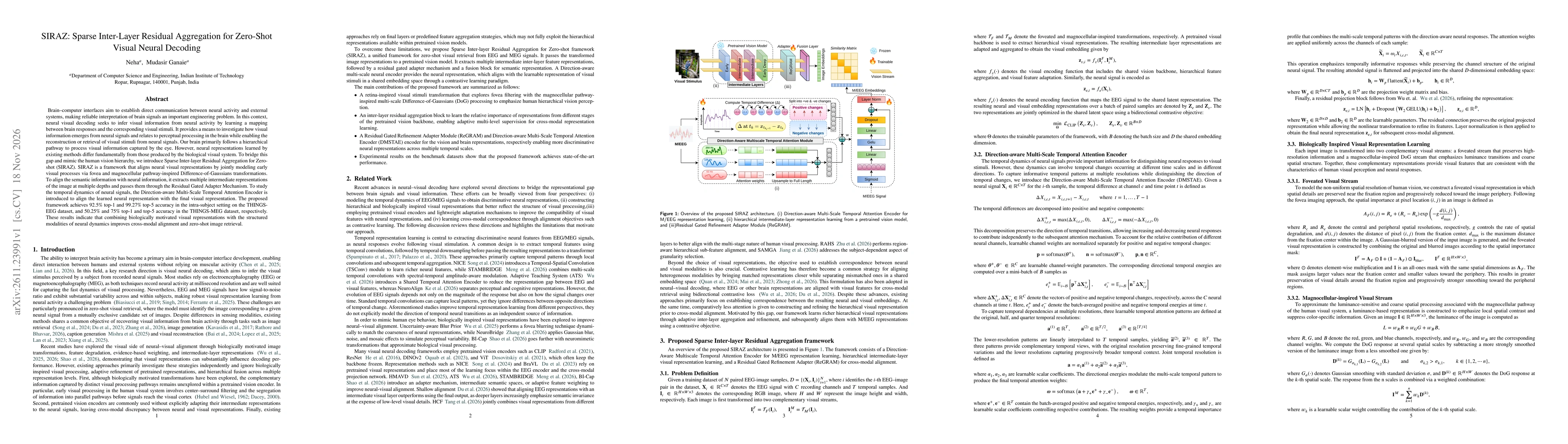
SIRAZ combines biologically inspired fovea- and magnocellular-pathway Difference-of-Gaussians transformations with a Residual Gated Adapter Mechanism to aggregate multiple intermediate visual representations from a pretrained vision backbone, and employs a Direction-aware Multi-Scale Temporal Attention Encoder to model temporal dynamics of EEG/MEG signals, aligning neural and visual embeddings via contrastive learning.
SignificanceWhy the work matters
The framework bridges the gap between biological visual processing and learned neural representations, showing that integrating biologically motivated visual streams with structured neural dynamics markedly improves cross‑modal alignment and zero‑shot visual retrieval from brain signals.
Technical contributionsWhat the work introduces
Introduces Sparse Inter‑layer Residual Aggregation with a Residual Gated Adapter, and a Direction‑aware Multi‑Scale Temporal Attention Encoder for aligning neural and visual modalities in zero‑shot decoding.
NoveltyHow it differs from prior work
First framework to jointly apply fovea‑ and magnocellular‑inspired Difference‑of‑Gaussians preprocessing, hierarchical residual aggregation, and direction‑aware temporal attention for zero‑shot visual neural decoding.
Future workQuestions that remain
- Investigate mechanisms to reduce subject‑specific variability and improve cross‑subject generalization.
- Develop more transferable neural representations for zero‑shot decoding across subjects.
- Explore extensions of the biologically inspired visual transformations to other vision tasks.
Discussion 0